
In today’s fast-moving world, the role of technology in education has never been more important. Whether it’s using smart gadgets in the classroom or integrating artificial intelligence (AI) to personalise learning, technology is redefining how we teach and learn. In this article we’ll explore how education is being transformed by technology, what types of tools and gadgets are involved, the impact of AI, real-world examples, the benefits and challenges, and what the future might hold. By reading this, you will gain a clear understanding of how technology, gadgets and AI work together to shape the landscape of education.
What is Technology in Education?
Defining Terms
- Education refers to the structured process of teaching and learning, whether in schools, colleges, workplaces or online environments.
- Technology in this context covers digital tools, software, hardware, networks, platforms and gadgets used to facilitate education.
- Artificial Intelligence (AI) is a subset of technology where machines or software simulate human-like intelligence: learning, reasoning, adapting.
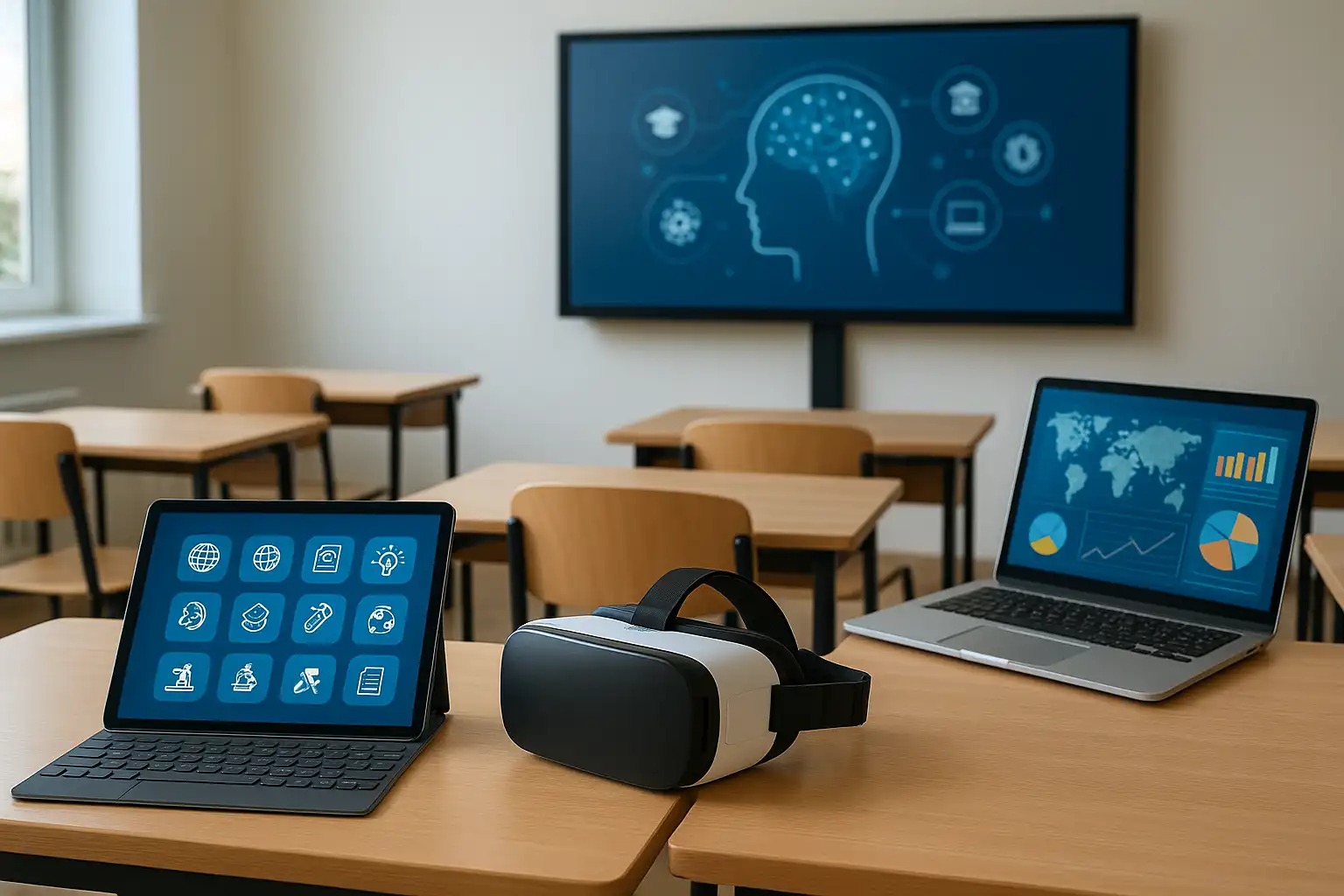
- Gadgets are the physical devices—tablets, smartphones, laptops, VR headsets, smart whiteboards—that students and educators use to engage with technology and AI.
How They Fit Together
In modern learning environments, gadgets allow students to access content, interact with teachers and collaborate with peers. Technology provides the infrastructure (software, platforms, cloud systems). AI adds adaptivity and personalization: analysing data to tailor instruction, provide feedback, identify where a student is struggling. Together, education + technology + AI + gadgets form a system where learning is more flexible, engaging and accessible.
Why the Role of Technology in Education Matters
Increasing Accessibility & Inclusion
Technology and gadgets open up education to learners who may otherwise be excluded. For example, digital platforms let remote learners join in, and AI-driven tools help tailor instruction for different needs. According to one source, “technology is essential to transform education by improving learning outcomes, increasing accessibility and creating individualised learning experiences.”
Personalised Learning via AI
The role of artificial intelligence (AI) in education is growing. A report shows that the global AI in education market reached US $7.57 billion in 2025, up 46% from 2024. Also, AI is being used to personalise instruction, adapt to learners’ pace and style, and make gadgets and platforms smarter.
Engagement and Modern Learning Methods
With the introduction of VR/AR gadgets, gamification and interactive platforms, technology brings new ways of teaching and learning that may be more engaging than traditional methods. For instance, immersive learning experiences help students visualise complex concepts.
Efficiency and Analytics
Gadgets and AI tools also support teachers and institutions: analysing student data, automating administrative tasks, providing feedback. A survey found teachers who use AI tools weekly save on average 5.9 hours per week—equivalent to about six weeks of a school year.
Preparing for the Future Workforce
In a world increasingly shaped by technology and artificial intelligence, ensuring that education incorporates these elements is vital for preparing students. According to the United Nations Educational, Scientific and Cultural Organization (UNESCO), AI has the potential to address major educational challenges but must be used in an inclusive and equitable way.
Key Areas Where Technology Impacts Education
1. Gadgets in the Classroom
Gadgets such as tablets, laptops, interactive whiteboards, VR headsets, and smartphones are increasingly common in education. These devices enable students to:
- Access digital content anytime, anywhere
- Collaborate and communicate with peers and teachers
- Use interactive apps and platforms for learning
- Engage with AI-powered tools
These gadgets act as the physical interface through which technology and AI reach the learner.
2. Artificial intelligence (AI) and Adaptive Learning
AI is used to personalise learning by adapting to each student’s needs and speed. Examples include:
- Intelligent tutoring systems that adjust the challenge level
- Generative AI tools like ChatGPT helping students brainstorm, summarise or ask questions.
- AI analytics to track performance and identify where a student might need help.
3. Blended and Hybrid Models
Technology allows for blended education (mix of in-person + online) or fully online learning, supported by gadgets and AI. For example, learning management systems (LMS) on the cloud let students access courses remotely. According to one trend report, hybrid and flexible learning models are growing in 2025.
4. Immersive and Interactive Technologies
Virtual Reality (VR), Augmented Reality (AR), Mixed Reality (MR) are gadgets/technologies that make learning experiences more interactive. For example, VR can simulate historical worlds, scientific labs, or field trips. One source states that by 2025 spending on advanced technologies like AR/VR in education is expected to hit US $12.6 billion.
5. Administrative and Support Technologies
Beyond teaching and learning, technology in education supports administration, assessment, and feedback. AI and gadgets reduce teacher workload, automate grading, and support personalised feedback. The “AI dividend” for teachers is a notable example.
Real-World Examples
- A 2025 survey found that 86% of education organisations are now using generative AI.
- The UNESCO page on AI in education emphasises how AI can help address inequalities, innovate teaching and accelerate progress.
- A systematic review found that AI chatbots, generative tools and tutoring systems in programming education show improved learning outcomes but also highlight challenges like safety and over-reliance.
- A UK study warned that 92% of students are now using generative AI in their studies.
These examples show how technology, gadgets and artificial intelligence are already embedded in education systems globally.
Benefits of the Role of Technology in Education
Here’s a breakdown of key benefits when technology, AI and gadgets are well-integrated in education:
- Personalised learning: AI analyses student data to tailor content and pace.
- Greater accessibility: Gadgets and online platforms enable remote learning, access for students with disabilities or in rural areas.
- Engagement: Interactive gadgets and immersive tech make learning more motivating and memorable.
- Efficiency: Teachers save time; administrative tasks, grading and feedback can be supported by AI-tools.
- Skill development: Students gain digital literacy, critical thinking and experience with technology and AI—preparing for future careers.
- Data-driven insights: Technology enables learning analytics to identify trends, gaps and optimise instruction.
Challenges and Considerations
Despite the many advantages, the role of technology in education also faces several important challenges:
- Digital divide: Not all students or schools have access to the required gadgets, reliable internet or infrastructure. One study found only 30% of UK students had access to AI-powered learning tools at school.
- Teacher preparation and training: Many educators feel they lack training in AI and technology preparation. For example, 65% of higher-ed students believe they know more about AI than their instructors.
- Privacy and security: Use of gadgets and AI generates large amounts of student data. Institutions must safeguard this information and maintain student privacy.
- Over-reliance on technology: Technology should support—not replace—the educator. AI tools, gadgets and platforms must be used thoughtfully, or risk superficial learning.
- Academic integrity: With AI tools like ChatGPT, there are concerns about misuse (cheating) and unintended dependencies.
- Choosing the right gadgets and tech: Schools must select tools that align with curriculum goals, not just adopt shiny gadgets.
How to Effectively Use Technology, Gadgets & AI in Education
Here are practical tips for institutions, teachers and students to make the most of the role of technology in education:
- Choose gadgets and platforms that align with learning goals – Picking devices and software must reflect what students need to learn, not just what looks modern.
- Invest in teacher training – Teachers need to understand both the gadgets and the AI tools (how they work, how to integrate them).
- Ensure equitable access – Make sure students have gadgets, internet access and support, so that the digital divide is narrowed.
- Promote AI literacy and ethics – Teach students how to use AI responsibly, understand its limitations, avoid plagiarism, critically evaluate outputs.
- Blend traditional teaching with technology – Use gadgets, AI and platforms as part of a blended approach, not as a full replacement of human instruction.
- Use data and analytics to monitor progress – With AI and technology, teachers can track student performance and intervene early.
- Evaluate and iterate – Regularly assess if the technology and gadgets are enhancing education and adjust accordingly.
- Protect privacy and security – Ensure student data is safeguarded, devices are secure and usage policies are clear.
- Encourage student engagement with technology – Use interactive gadgets, gamified apps and AI tools to increase motivation and participation.
- Stay updated with emerging trends – Technology evolves rapidly; schools must stay aware of new gadgets, AI tools and best practices.
The Future of the Role of Technology in Education
Looking ahead, the role of technology, gadgets and artificial intelligence in education will deepen further:
- The global EdTech market is projected to reach hundreds of billions of dollars by 2025 and beyond.
- Hybrid and flexible learning models will become even more prevalent, supported by gadgets and cloud-based platforms.
- AI will play a stronger role in assessment, personalised feedback, tutoring systems and predictive analytics of student outcomes.
- Immersive gadgets (VR/AR) are likely to become more mainstream, making experiential learning more accessible.
- Education institutions will need to keep pace with technology policy, ethical AI use, and ensuring gadgets & infrastructure are delivered equitably.
As the role of technology in education grows, gadgets and AI will not simply support learning—they will help reshape education itself, making it more dynamic, student-centred and globally accessible.
Conclusion
In summary, the role of technology in education is multifaceted. From smart gadgets in the classroom to artificial intelligence that personalises learning and analytics that drive insights—education is being transformed. The synergy of technology, gadgets and AI offers greater accessibility, higher engagement, more tailored learning and better preparation for the future workforce. However, the success of this transformation hinges on addressing challenges like equitable access, teacher training, privacy, and responsible use of AI. As we look to the future, institutions, teachers and students must embrace the change, use gadgets and AI responsibly, and remain adaptive to emerging technology trends. In doing so, education can become more effective, inclusive and aligned with the demands of our digital world.
By embracing technology, using gadgets intelligently, and integrating AI thoughtfully, all stakeholders in education can unlock the full potential of modern learning. The role of technology in education is not just an enhancement—it is a cornerstone of how education evolves for the better.