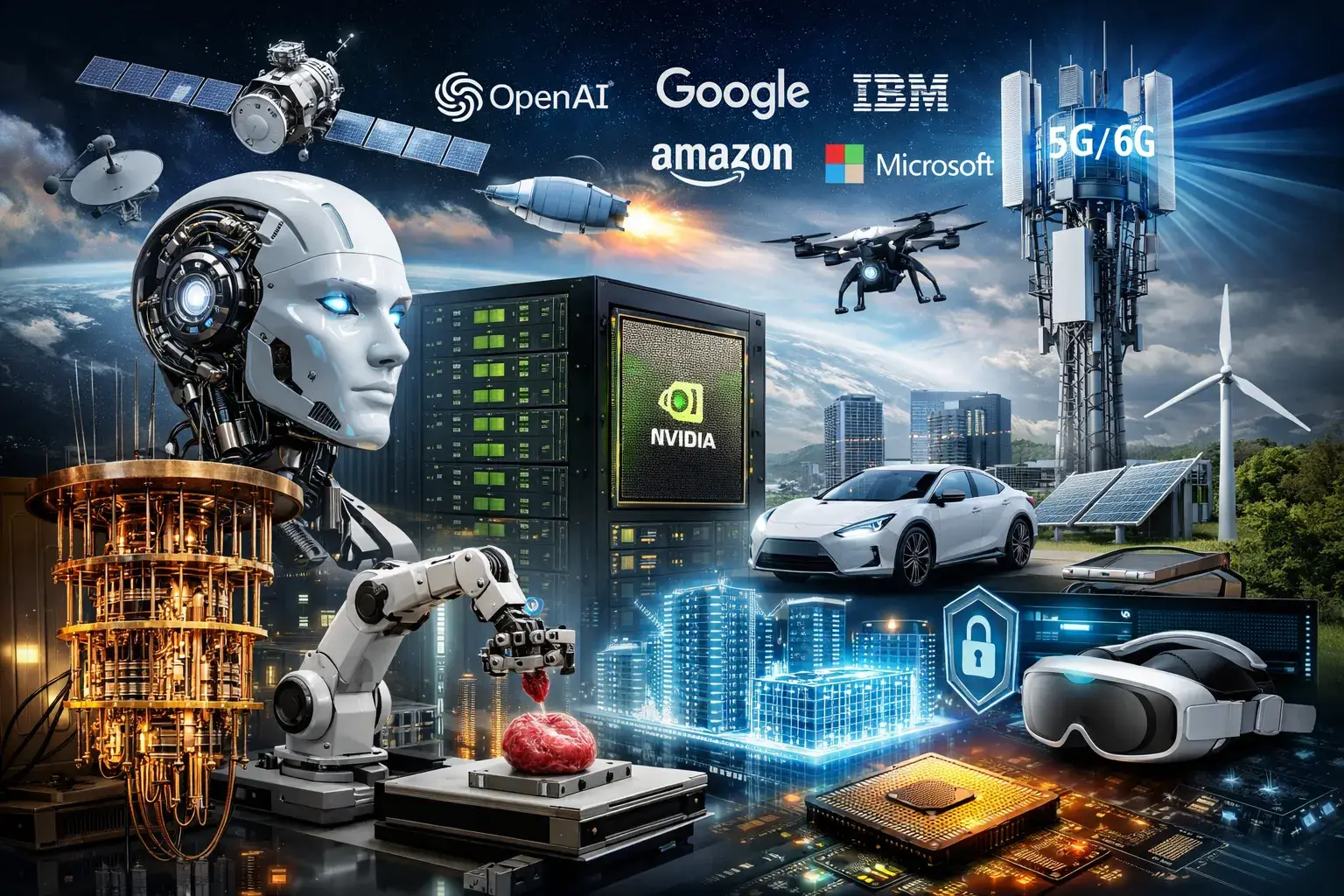
The technology landscape is evolving faster than ever, with innovation accelerating across industries like artificial intelligence, connectivity, computing, healthcare, and manufacturing. As we approach 2026, businesses, developers, and individuals must understand top technology trends of 2026 driving transformation, competitiveness, and new opportunities.
In this article, you’ll discover the top 20 technology trends of 2026, explained in simple terms with real examples and expected impact. These trends are backed by recent industry research from Gartner, StartUs Insights, BDO, and other expert analyses.
Top 20 Technology Trends of 2026
1. Artificial Intelligence Continues to Lead Innovation
Artificial intelligence (AI) remains the cornerstone of technology trends in 2026. Enterprises are moving beyond experimentation to fully integrating AI into core operations, from customer service automation to strategic decision support. Generative AI models like ChatGPT have shown how AI tools can augment human creativity and productivity.
2. Agentic AI and Autonomous Workflows
2026 is set to be the year of agentic AI, where intelligent systems not only assist but act autonomously — making decisions and executing workflows without constant human input. These agents can interact with tools, systems, and data with minimal supervision.
3. AI Supercomputing Platforms
AI supercomputing systems combine CPUs, GPUs, specialized accelerators, and orchestration software to power large-scale machine learning and analytics. This trend enables real-time insights at enterprise scale.
4. AI Security Platforms
As AI becomes more interconnected, AI security platforms are emerging to defend against new threats like prompt injection, data poisoning, and rogue agents. These systems centralize protection, visibility, and governance.
5. AI-Native Development Tools
AI-native development platforms are transforming software engineering by embedding AI into coding, testing, and deployment tasks. This trend speeds up development while lowering barriers to entry.
6. Confidential and Trusted Computing
Protecting sensitive data in untrusted environments is becoming essential. Confidential computing achieves this by isolating workloads in secure hardware environments — a must-have for regulated industries.
7. Physical AI: Robotics and Smart Machines
Physical AI merges intelligence with machines such as robots and autonomous drones. These systems don’t just compute — they sense, decide, and act. This expands automation beyond software into real-world tasks.
8. Hybrid and Distributed Cloud Infrastructure
Hybrid IT — combining public cloud, private cloud, and edge environments — becomes the default approach for most enterprises. This provides flexibility, resilience, and control.
9. Edge Computing and Edge AI
Processing data closer to where it is generated improves responsiveness and reduces latency. Edge computing, paired with edge AI, enables real-time intelligence for devices like smart sensors and autonomous systems.
10. 5G Expansion and 6G Emergence
5G networks will achieve near-ubiquitous coverage in many urban areas by 2026, while early 6G development promises even faster speeds and lower latency, supporting ultra-connected devices.
11. Extended Reality (XR) Goes Mainstream
Extended reality — including AR (augmented reality) and VR (virtual reality) — transitions from niche to widespread adoption in training, collaboration, and customer engagement.
12. Quantum Computing Nears Practical Use Cases
Quantum computing continues its progress toward real-world applications, particularly in optimization, simulation, and cryptography. Hybrid quantum-AI systems begin to solve problems beyond classical computing.
13. Bioprinting and Digital Health Tech
Bioprinting — using 3D printing to produce biological tissues — advances toward clinical applications, while digital health tech powered by AI enables personalized diagnostics and preventive care.
14. Cybersecurity Evolves With AI Integration
Cybersecurity is transforming with AI-driven detection and automated response systems, defending against increasingly sophisticated threats while preserving privacy.
15. Zero Trust and Identity-Based Security
Zero trust principles — where all access is continuously verified — become standard practice, especially in cloud and hybrid environments.
16. Smart Infrastructure and IoT 2.0
Connected sensors and IoT devices become critical infrastructure components, enhancing smart cities, industrial automation, and logistics networks.
17. Automation and Hyper-Automation
Organizations are automating entire workflows, not just isolated tasks. Hyper-automation uses AI, robotics, and orchestration tools to optimize end-to-end processes.
18. Digital Twins for Operational Insight
Digital twin technology creates virtual replicas of systems and infrastructure, optimizing performance through real-time simulation and predictive maintenance.
19. Sustainability Tech and Green Innovation
Technology isn’t just about speed and power — it’s about sustainability. AI-enhanced systems increase energy efficiency, reduce emissions, and support responsible computing.
20. Ethical and Trustworthy Tech Frameworks
As technology permeates every aspect of life, greater emphasis is placed on ethics, governance, and human-centric design — ensuring innovations are safe, fair, and transparent.
Conclusion
The top technology trends of 2026 point to a future where digital intelligence, connectivity, and automation are deeply integrated into our daily lives and business operations. From AI security platforms to quantum computing, hybrid cloud infrastructures to extended reality, these trends are reshaping how organizations innovate and compete.
Understanding and adopting these technology trends early can empower businesses to lead, adapt, and grow in an era of rapid change. Whether you’re a developer, entrepreneur, or tech enthusiast, staying informed about these trends will help you prepare for what lies ahead.