
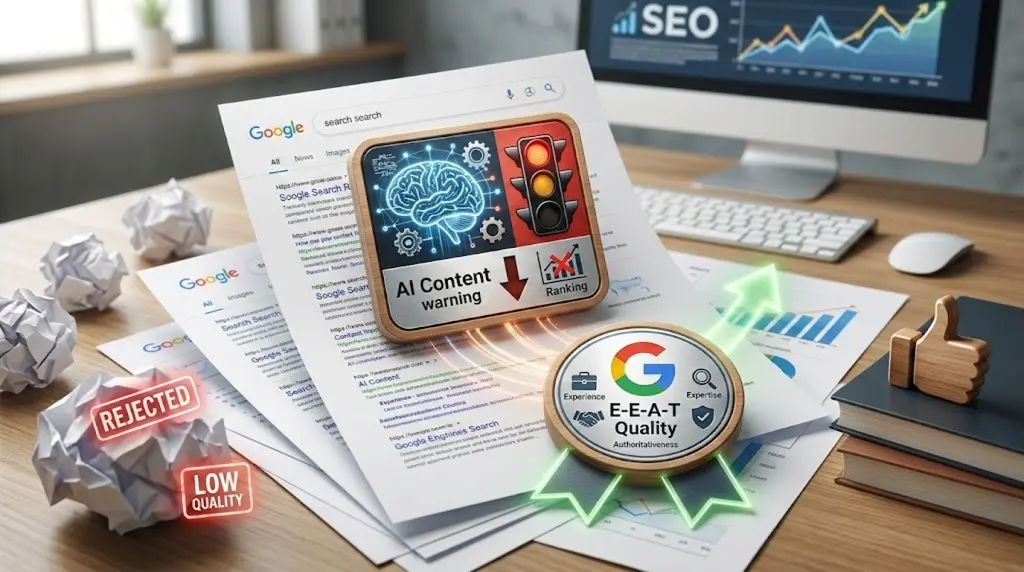
The AI content SEO impact is one of the most talked-about topics in digital marketing today. Millions of websites are now using artificial intelligence to produce blog posts, product pages, and social media copy faster than ever before. But does this help or hurt your chances of ranking on Google? The answer is not simple. It depends heavily on how you use the tool and whether your content follows Google’s quality guidelines.
In this article, you will learn exactly what Google thinks about AI-generated content, how it can damage your rankings if done wrong, and how it can genuinely help your SEO when done right. Whether you are a beginner or a seasoned marketer, this guide will give you a clear picture of where things stand in 2025 and beyond.
What Is AI-Generated Content?
AI-generated content is text, images, or other media created by tools powered by artificial intelligence. Tools like ChatGPT, Gemini, Jasper, and others can write full blog posts, product descriptions, and even news articles in seconds. These tools use large language models (LLMs) trained on massive amounts of internet data to predict and produce human-like text.
This technology is not new. Automation has been used for years to create weather reports, sports scores, and financial summaries. What has changed is the scale and speed. Anyone can now generate thousands of pages of content with just a few clicks. And that is exactly where the problem begins.
Google’s Official Stance on AI Content
Many people assume Google automatically penalizes AI-generated content. That is not accurate. Google’s official position is clear: it rewards high-quality content, regardless of how it is produced. The search engine’s quality guidelines do not ban AI writing. Instead, they focus on the purpose and quality of the content itself.
According to Google’s Search Central blog, using automation or AI to create content is only a problem when it is done to manipulate search rankings. Their spam policies say that content created primarily to game algorithms — not to help people — is a violation. This is a critical distinction. The AI content SEO impact is not determined by who or what wrote the content. It is determined by whether the content genuinely serves the reader.
In January 2025, Google updated its Search Quality Rater Guidelines for the first time to directly define generative AI. The update describes it as “a useful tool” that “can also be misused.” Google’s 16,000+ quality raters now actively look for signs of low-effort, mass-produced AI content that fails to meet their quality guidelines.
How AI Content Can Hurt Your SEO
1. Mass Production Without Value
The biggest risk is publishing large amounts of AI content without any human editing or real value added. AI content SEO impact turns negative when sites flood the web with thin, repetitive posts just to grab keywords. Google’s updated quality guidelines now specifically target what they call “scaled content abuse” — creating many pages with little effort or originality.
A real-world example: an SEO experiment tracked 20 websites built entirely with unedited AI content. The sites initially ranked. But by February 2025, all keyword rankings were lost — either through algorithm updates or manual review. Short-term gains from low-effort content rarely survive long.
2. Low E-E-A-T Signals
Google evaluates all content using E-E-A-T — which stands for Experience, Expertise, Authoritativeness, and Trustworthiness. These are the core pillars of their quality guidelines. AI tools cannot demonstrate personal experience. They cannot perform original research. They cannot hold real credentials.
When a page lacks E-E-A-T signals, it struggles to rank — especially on sensitive topics like health, finance, or legal advice. The AI content SEO impact is most damaging in these so-called “Your Money or Your Life” (YMYL) categories, where trust and accuracy are critical. Google’s quality guidelines are strictest here.
3. Poor User Experience and High Bounce Rates
Readers can tell when content feels hollow or generic. If someone lands on your page and leaves immediately, that is a negative user signal. Google tracks behavior like bounce rate, time on page, and scroll depth. When users bounce quickly, it tells Google the content did not satisfy their intent.
Unedited AI content often reads like filler. It can be vague, repetitive, and lacking in real insight. This directly affects AI content SEO impact in a very practical way — poor engagement kills rankings over time, regardless of keyword placement.
4. Penalties from Manual Reviews
Google employs over 16,000 human quality raters who assess web pages using detailed quality guidelines. These raters can mark pages as “Lowest Quality” if they appear to be mass-produced with minimal editorial effort. Pages rated as low quality feed into the machine learning systems that power Google’s algorithm. Too many low-quality pages on a domain can result in sitewide ranking drops or even blacklisting.
The AI content SEO impact of a manual action can be severe. In 2024, Google applied manual penalties to multiple websites relying heavily on auto-generated content. Some were completely removed from search results.
5. Originality Problems
Because AI is trained on existing content, it naturally tends to produce writing that mirrors what already exists online. This creates originality issues. If your AI-written blog post sounds almost identical to dozens of others covering the same topic, there is no reason for Google to rank yours above the others. Google’s quality guidelines consistently stress unique value as a core ranking signal.
How AI Content Can Help Your SEO
1. Faster Research and Content Planning
When used as a research and planning assistant, AI can be incredibly powerful. It helps identify topic clusters, generate content outlines, suggest headings, and find semantic keyword opportunities. This part of the process does not violate any quality guidelines, and it saves content teams hours of work.
The positive side of AI content SEO impact starts here — with smarter strategy, not lazy automation. AI helps writers focus on what matters most: creating content that actually answers real user questions.
2. Scaling Content With Human Oversight
For businesses that need to cover hundreds or thousands of topics, AI can provide the first draft. A skilled human writer then reviews, enriches, and personalizes the content. This hybrid approach aligns well with Google’s quality guidelines. The key requirement is that a real person adds original value — personal insight, expert opinions, case studies, or updated data.
This model has worked for e-commerce businesses that use AI to generate base product descriptions, then have human editors add brand voice, technical detail, and unique selling points. The AI content SEO impact in these cases tends to be positive because the final output is genuinely useful.
3. Better Keyword Coverage and Structure
AI tools trained on SEO data can help writers hit the right keywords, structure content logically, and improve readability scores. When guided by a skilled editor, these tools help content meet Google’s quality guidelines more consistently. Features like proper heading hierarchies, FAQ sections, and internal linking become easier to implement at scale.
4. Supporting Content Types That AI Handles Well
AI has always worked well for certain content types: weather data, financial summaries, product specs, sports stats. These are factual, structured, and low-risk. The AI content SEO impact is neutral to positive in these contexts because the content is accurate, expected, and serves a real purpose. This is exactly what Google’s quality guidelines consider acceptable use of automation.
5. Faster Turnaround Without Sacrificing Quality (When Done Right)
Speed is a real advantage for SEO. Being first to cover a trending topic can earn backlinks, social shares, and early traffic. AI helps teams move faster without cutting corners — provided the output goes through a strict editorial process aligned with quality guidelines. A well-edited AI-assisted piece published quickly can outperform a slow-moving, all-human process.
What Google’s 2025 Quality Guidelines Actually Say
Google’s updated Search Quality Rater Guidelines, released in January 2025, made several important changes around AI. Here is what content creators need to know:
- Google now officially defines generative AI within its quality guidelines document for the first time, calling it a “helpful tool” that can be misused.
- Content raters are instructed to flag “scaled content abuse” — mass-produced content with no original value — as spam. This applies to both AI and human-written content.
- Pages with “filler” content — text that looks substantial but adds no real information — are now directly addressed in the quality guidelines as low quality.
- Exaggerated claims about authorship or credentials are now treated as misleading. Raters are told not to simply take your word for it — they verify.
- E-E-A-T requirements have been extended beyond health and finance topics. Even entertainment and lifestyle blogs must now show signs of genuine expertise.
Understanding these quality guidelines is not optional. They directly shape how Google’s algorithm is trained. Every content decision you make should reflect them.
Best Practices for Using AI in Your SEO Content Strategy
Always Add Human Expertise
Never publish raw AI output. Always have a subject-matter expert or skilled editor review the content. Add personal stories, real data, original opinions, or case studies. This is what separates content that meets quality guidelines from content that fails them.
Follow E-E-A-T at Every Step
Display author bios with real credentials. Link to authoritative sources. Keep content updated and accurate. Use schema markup to help Google understand who created the content and what it covers. These steps directly support E-E-A-T compliance and improve your AI content SEO impact.
Write for Readers, Not Algorithms
Google’s quality guidelines make one thing clear above all else: content must be created for people. Ask yourself: “Does this fully answer the reader’s question? Would someone find this genuinely useful?” If the answer is yes, you are on the right track. If you are writing for bots, your AI content SEO impact will suffer.
Use AI for Research, Structure, and Optimization — Not Just Writing
The safest and most effective way to use AI in your SEO workflow is to treat it as a research assistant, outline builder, and optimization checker. Let humans do the actual writing. This approach consistently aligns with Google’s quality guidelines and produces better results over time.
Monitor Performance and Adjust
Track key engagement metrics: time on page, bounce rate, pages per session, and conversions. If AI-assisted pages underperform, revisit them and improve. Good AI content SEO impact is always measurable. Use the data to continuously improve your editorial process.
The Bigger Picture: AI Overviews and SEO in 2025
Beyond just content creation, AI is also changing how search results look. Google’s AI Overviews — summaries that appear at the top of search results — now show up for a growing share of queries. Studies show that when an AI Overview appears, organic click-through rates can drop significantly for the pages below it.
By early 2025, AI Overviews appeared in roughly 12-25% of search queries, with much higher rates in information-heavy industries like health and technology. This means the AI content SEO impact goes beyond just your own writing decisions. It affects how often searchers even reach your content at all.
To be cited inside Google’s AI Overviews, your content must be deeply trusted. That means strong backlinks, clear authorship, schema markup, and — most importantly — meeting Google’s quality guidelines with every piece you publish. Structured data, FAQ sections, and detailed expert content are all factors that increase your chances of appearing inside AI-generated summaries.
Conclusion
The AI content SEO impact is real, and it cuts both ways. Used responsibly — with human oversight, expert editing, and a focus on genuine reader value — AI becomes a powerful tool that helps you scale your content and improve your SEO. Used carelessly — to generate bulk pages without thought, editing, or original insight — it can destroy your rankings and your credibility.
Google’s message through its quality guidelines is consistent and clear: quality content wins. The method of creation does not matter. What matters is that your content is helpful, accurate, original, and trustworthy. Whether you use AI as a co-writer or as a planning tool, always bring human judgment to the table. That is the only approach that satisfies Google’s quality guidelines and builds lasting SEO success. The smartest move you can make today is to understand the AI content SEO impact fully — and use that knowledge to create content that people and search engines both genuinely value.