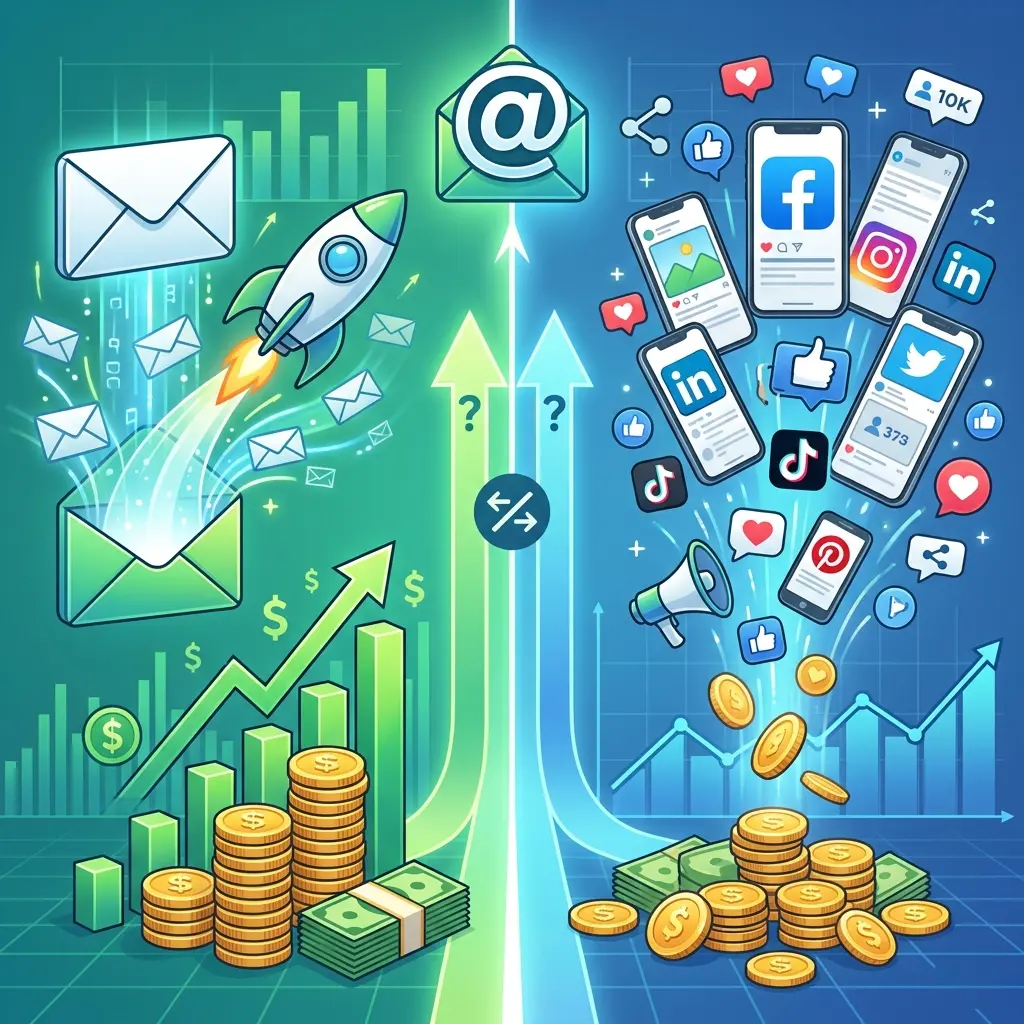
If you are running a business or managing a marketing budget, you have probably asked this question before: should I focus on email marketing vs social media? Both channels are powerful. Both have millions — even billions — of users. But when it comes to real returns, the answer is not a tie.
This article digs into the latest 2026 data to help you understand which channel drives better results. We will look at email marketing ROI statistics, break down social media vs email engagement numbers, and help you figure out the best channel for digital marketing based on your goals.
Let us get straight into it.
What Is Email Marketing and How Does It Work?
Email marketing is when a business sends messages directly to people through email. These messages can be promotions, updates, newsletters, or automated sequences. The receiver has usually signed up or given permission to receive these emails.
Because the person opted in, email feels more personal. You are not fighting for attention in a crowded social feed. You are landing right in someone’s inbox — a place they check every single day.
In 2026, there are approximately 4.73 billion email users worldwide. That is more than half the planet. And according to multiple industry reports, 99% of email users check their inbox at least once daily. Some check it up to 20 times a day.
What Is Social Media Marketing and How Does It Work?
Social media marketing means using platforms like Instagram, Facebook, TikTok, LinkedIn, and X (formerly Twitter) to promote your brand. You can post organic content for free, or you can run paid ads to reach a wider audience.
Social media is excellent for discovery. When someone does not know your brand yet, a well-placed Instagram reel or a trending TikTok can introduce you to thousands of new people in hours.
But there is a catch. Platforms control who sees your content. Facebook’s algorithm, for example, now shows brand posts to roughly 5% of followers. That means if you have 10,000 followers, only about 500 people see your organic post. To reach more, you usually have to pay.
Email Marketing ROI Statistics: The Numbers That Matter in 2026
Let us talk numbers, because email marketing ROI statistics are genuinely eye-opening.
According to Litmus and HubSpot’s 2026 State of Marketing Report, email marketing generates between $36 and $42 for every $1 spent. Some industries, like retail and e-commerce, see as high as $45 per $1 invested. In the US e-commerce space, that number can jump to $72 for every dollar.
That is a return of 3,600% to 4,200%. No other digital marketing channel consistently hits those numbers.
Here are some key email marketing ROI statistics you should know for 2026:
- Email marketing ROI averages $36–$42 per $1 spent (Litmus, 2026)
- Automated emails drive 37% of all email-generated orders from just 2% of email sends (Omnisend)
- Abandoned cart emails achieve a 50.5% open rate and a 3.33% conversion rate (Klaviyo)
- Personalized emails have a click-through rate of 41% (DemandSage, 2026)
- Marketing professionals report a 760% increase in revenue from email list building (Campaign Monitor)
- 89% of marketers use email as their primary channel for lead generation (EmailChef, 2026)
- 4 out of 5 marketers say they would rather give up social media than give up email (HubSpot)
These email marketing ROI statistics make it very clear: email is one of the highest-performing tools in any digital marketer’s arsenal.
Social Media ROI Statistics: What the Data Says in 2026
Social media marketing has grown massively. There are over 5 billion social media users globally, and platforms like Instagram and TikTok continue to attract huge audiences.
But when it comes to pure ROI, social media struggles to keep pace with email. According to Sender.net’s 2026 marketing ROI data:
- Facebook Ads average around $1.75 for every $1 spent — down from $4 just a few years ago
- Social networks drove 17.11% of total online sales in 2025 (Statista via Sprout Social)
- 81% of consumers are influenced by social media to make impulse purchases (Sprout Social Index 2025)
- 76% of consumers discover new brands through platforms like Instagram and TikTok
- Short-form video delivers the highest ROI of any social content format (HubSpot, 2026)
Paid social can deliver decent returns, especially for brand discovery and retargeting. But organic social media ROI is harder to measure and generally lower than email in terms of direct conversions.
Social Media vs Email Engagement: A Side-by-Side Look
Understanding social media vs email engagement helps you see where your audience is more responsive.
Email Engagement Rates in 2026
- Average email open rate: 30.7% (up from 26.6% in 2024) — a fifth consecutive year of growth (Omnisend)
- Average email click-through rate: 2.5% (HubSpot, 2025)
- Automated email open rate: 40.55%
- Welcome email open rate: 83.6% (GetResponse)
- Conversion rate for B2C email: 2.8% (FirstPageSage, 2025)
Social Media Engagement Rates in 2026
- Average organic reach on Facebook: ~5% of total followers
- Average Instagram engagement rate: 0.5–1.5% depending on industry
- Social media click-through rates are typically 50–100 times lower than email CTRs
- Conversion from organic social: often below 1% for most brands
When you compare social media vs email engagement side by side, the gap is clear. Email consistently gets more opens, more clicks, and more conversions per contact. People who give you their email address are more committed than people who casually follow a page.
Email Marketing vs Social Media: Cost Comparison
Budget matters. So let us look at what each channel actually costs.
Email marketing is one of the most affordable marketing channels available. Monthly platform costs typically range from $51 to $1,000 depending on your list size and tool. For small businesses, many platforms offer free plans up to a certain number of subscribers.
Social media marketing, especially when you factor in paid ads, is far more expensive. Professional social media management services can cost $500 to $5,000 per month. And with organic reach declining, spending on ads is no longer optional for most brands trying to grow.
This cost gap is one big reason why email marketing ROI statistics look so much stronger. You spend less and earn more per dollar.
Best Channel for Digital Marketing: When to Use Email vs Social Media
The debate of email marketing vs social media is not really about choosing one and ditching the other. It is about knowing when and how to use each.
Choose Email Marketing When You Want To:
- Drive direct sales and conversions
- Nurture leads through a buying journey
- Send personalized offers to segmented audiences
- Retain existing customers and reduce churn
- Recover abandoned carts and lost revenue
- Build a long-term owned audience that no algorithm can touch
Choose Social Media When You Want To:
- Increase brand awareness among new audiences
- Build community and encourage conversations
- Showcase products visually through images and video
- Leverage viral content and influencer partnerships
- Run retargeting campaigns using paid ads
- Drive people to sign up for your email list
The best channel for digital marketing is often the one that matches your current goal. For top-of-funnel discovery, social media wins. For mid-to-bottom funnel conversion, email wins — and the email marketing ROI statistics back this up overwhelmingly.
Owned vs Rented: Why Email Gives You More Control
One of the most important differences in the email marketing vs social media debate is ownership.
Your email list is an asset you own. When someone gives you their email address, you have a direct line to them forever — until they choose to unsubscribe. No platform can take that away. No algorithm change can make your emails invisible overnight.
Social media, on the other hand, is rented land. You are building your audience on someone else’s platform. If Facebook changes its algorithm, your organic reach drops. If TikTok gets restricted in certain regions, your audience disappears. If a platform shuts down, so does your community.
This is why 80% of marketers say they would give up social media before they gave up email, according to HubSpot. Email gives you stability. Social media gives you reach. The best channel for digital marketing long-term is one you control.
How Personalization Changes the ROI Game
Both channels can be personalized, but email does it far better at scale.
Personalized email campaigns generate a median ROI of 122%. They achieve a 29% higher open rate and a 41% higher click-through rate compared to generic emails. When you segment your audience and send the right message to the right person at the right time, the results multiply.
Social media personalization is limited. You can target by demographics and interests in paid ads, but you cannot tailor individual content the same way email can. This is another reason why social media vs email engagement comparisons tend to favor email — the relationship is deeper and more direct.
Automation: Where Email Really Pulls Ahead
Email marketing automation is one of the biggest drivers of high email marketing ROI statistics in 2026.
Automated emails make up only 2% of total email volume, yet they drive 30% of all email revenue. They earn 16 times more per send than standard campaign emails. This includes:
- Welcome series (open rates averaging 83.6%)
- Abandoned cart sequences (recovering 3–5% of lost sales)
- Post-purchase follow-ups
- Re-engagement campaigns for inactive subscribers
- Birthday and anniversary emails (with 4x higher average order values)
Social media does not have a native equivalent for this level of automated, personal, one-to-one communication. This makes automation a decisive factor when evaluating the best channel for digital marketing in terms of long-term revenue.
B2B vs B2C: Does the Channel Choice Change?
In the email marketing vs social media debate, your business type matters.
For B2C brands, HubSpot’s 2025 State of Marketing Report found that email marketing is the number one ROI-driving channel, followed by paid social and content marketing. Direct promotional emails convert consumers who are already interested and close to buying.
For B2B brands, the top ROI channel is website, blog, and SEO — but email is a close and essential second. LinkedIn plays a much stronger role in B2B social media vs email engagement because it is a professional platform. However, email still converts leads into clients at a higher rate once trust has been built.
In both B2B and B2C, the social media vs email engagement data points in the same direction: social builds awareness, email closes deals.
Real-World Example: What a Split Budget Looks Like
Imagine an e-commerce brand spending $500 per month on each channel.
With $500 on email marketing, using the average $36 ROI per $1, that brand could potentially generate $18,000 in revenue. With email automation doing the heavy lifting, the ROI compounds over time as the list grows.
With $500 on social media ads at an average Facebook Ads ROI of $1.75 per $1, the expected revenue is around $875. Unless the campaign is highly optimized or uses retargeting, the gap is enormous.
This is not to say social media is useless — far from it. But these email marketing ROI statistics show why savvy marketers prioritize building and nurturing their email lists above almost every other channel.
Combining Both Channels: The Smart Approach
The sharpest marketers do not treat this as a binary choice. They use social media to grow their email list, and they use email to convert the leads social media brings in.
Here is how a combined strategy works in practice:
- Run Instagram or Facebook lead ads to collect email sign-ups
- Offer a free download, discount, or valuable resource in exchange for an email address
- Send a welcome email sequence to new subscribers immediately
- Use email to educate, nurture, and convert those leads into paying customers
- Share social proof and community content on social media to strengthen brand trust
- Retarget email subscribers on Facebook and Instagram for multi-touch conversion
When you combine the reach of social media with the conversion power of email, the result is greater than what either channel produces alone. That is how you truly unlock the best channel for digital marketing potential.
Key Takeaways: Email Marketing vs Social Media in 2026
- Email marketing ROI statistics consistently show returns of $36–$42 per $1 spent — far outperforming social media
- Social media vs email engagement data favors email in terms of open rates, click-through rates, and conversions
- Social media excels at discovery and building awareness with new audiences
- Email gives you ownership and direct access that social media can never guarantee
- Automation makes email a passive revenue machine that runs even while you sleep
- The best channel for digital marketing depends on your goal — but for ROI, email wins
- Using both channels together is the most effective long-term strategy
Conclusion
The email marketing vs social media debate has a clear winner when it comes to pure return on investment: email. The data from 2026 is consistent across every major research source. Email marketing ROI statistics show returns that social media simply cannot match on a per-dollar basis.
That does not mean you should abandon social media. Platforms like Instagram, LinkedIn, and TikTok are still vital for brand visibility, community building, and bringing new people into your world. But once someone discovers you, email is the channel that turns that interest into real revenue.
If you have been debating where to focus your marketing energy, the answer is clear. Build your email list. Invest in good email sequences. Use social media to grow that list. And measure everything so you know exactly what is working.
Understanding social media vs email engagement is not just a statistic exercise — it is a business decision. And in 2026, the best channel for digital marketing that consistently delivers results is email. Start there, combine it smartly with social, and watch your ROI grow.