If you’ve been hearing the phrase generative AI everywhere lately — in news headlines, at the office, or from friends — you’re not alone. What is generative AI, and why does it seem like the entire world is talking about it? The good news is that you don’t need a computer science degree to understand it. This guide breaks down everything clearly and simply. By the end, you will know exactly what generative AI is, understand how generative AI works, and see real generative AI examples that are already changing daily life in 2026.
What Is Generative AI? The Simplest Definition
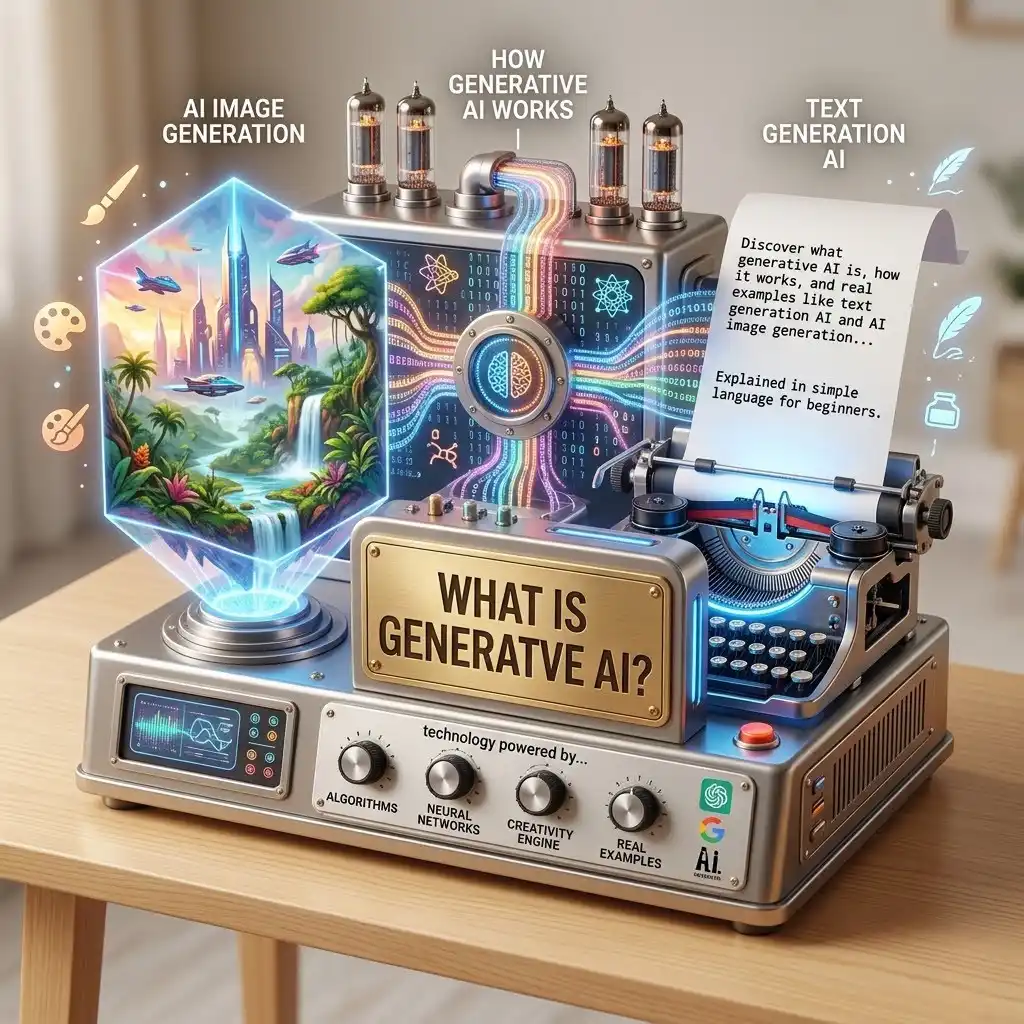
Generative AI is a type of artificial intelligence that can create brand-new content. That content could be a piece of writing, a painting, a music track, a video, or even computer code — all produced from a simple text instruction you type in.
Unlike older software that only follows strict, pre-written rules, generative AI learns from enormous amounts of existing data. It studies patterns in that data and then uses those patterns to build something entirely new on its own.
A simple way to picture it: imagine reading ten million books, articles, and websites. After all that reading, you could now write your own book on almost any topic — quickly and fluently. That is essentially what generative AI does, except it works at a speed and scale no human ever could.
According to Statista, the generative AI market is projected to reach approximately $66.89 billion in 2026 and grow to over $442 billion by 2031. These figures show that this technology is not a passing trend — it is becoming a core part of how the modern world operates.
How Generative AI Works: A Step-by-Step Breakdown
Understanding how generative AI works is simpler than it sounds. There are three main stages, and each one builds on the last.
Stage One: Training on Massive Data
The first stage of how generative AI works is called training. During this phase, the AI model is fed billions of examples — text articles, books, images, audio recordings, videos, and more. The system reads and processes all of this data to search for patterns. This training phase can take weeks and requires powerful computer hardware.
Stage Two: Learning Patterns and Relationships
Once enough data has been absorbed, the AI builds a kind of internal “map” of how things connect. In text generation AI, for example, the system learns that certain words tend to follow other words. In AI image generation, it learns that a sunset sky tends to have warm orange and pink tones, and that these blend naturally with the horizon.
These are not simple memorized facts. They are statistical relationships — deep connections the AI has identified by analyzing millions of real-world examples.
Stage Three: Generating New Content From a Prompt
This is the most exciting part of how generative AI works. Once trained, the system is ready for use. When you type a prompt — a question, instruction, or description — the AI uses everything it has learned to generate a response. This response is completely new. It was not pulled from a database or copied from somewhere. The AI built it from scratch using the patterns it understands.
This is why how generative AI works is considered a major breakthrough in technology. Previous AI systems could only recognize and classify things. Generative AI can create things — and that changes everything.
The Main Types of Generative AI Output
Generative AI does not produce just one type of content. Here are the four most important categories to know about.
Text Generation AI
Text generation AI is the most widely known type of generative AI today. It refers to AI systems that can write — emails, articles, summaries, scripts, code, social media captions, product descriptions, and much more.
Text generation AI works by predicting what word, sentence, or paragraph should logically come next, based on the patterns it learned during training. The results are often remarkably natural and human-like.
Popular text generation AI tools in 2026 include ChatGPT, Google Gemini, Claude, and Microsoft Copilot. According to recent data, 75% of workers now use tools like these in their daily work — making text generation AI one of the fastest-adopted technologies in history.
Text generation AI is also widely used in customer service chatbots, healthcare report drafting, legal document writing, and educational tutoring platforms. Its applications are growing every month.
AI Image Generation
AI image generation is another major output category of generative AI. With AI image generation, a user simply types a description — for example, “a futuristic city at night in the style of a watercolor painting” — and the AI produces a detailed, fully rendered image in seconds.
AI image generation tools use a process called diffusion modeling. The model starts with what looks like random visual noise and gradually refines it — step by step — into a clear and detailed image that matches the description given. It is a remarkable process that produces impressively realistic or stylized results.
Popular AI image generation tools in 2026 include DALL-E (from OpenAI), Midjourney, Stable Diffusion, Adobe Firefly, and Google’s Imagen 4. Each AI image generation tool has a different visual style and strength.
The scale of AI image generation today is staggering. Approximately 34 million AI-generated images are created every single day across more than 2,000 platforms worldwide. AI image generation has moved far beyond a novelty — it is now a professional tool used by designers, marketing teams, architects, and filmmakers.
Audio and Video Generation
Generative AI can also produce music, voice recordings, and full short videos. Tools like OpenAI’s Sora and Google’s Veo allow users to generate video clips from text descriptions alone. By 2026, estimates suggest that 75% of marketing videos will be AI-generated or AI-assisted. This shift is happening faster than most people expected.
Code Generation
Generative AI can write, complete, and debug computer code. GitHub Copilot — one of the most used generative AI examples in software development — now assists developers at 90% of Fortune 100 companies. Research shows that AI coding tools can cut code documentation time by 45 to 50%, freeing developers to focus on more complex, creative problem-solving.
Real-World Generative AI Examples You Probably Already Know
Let’s look at some everyday generative AI examples that may already be part of your life — even if you didn’t realize it.
- ChatGPT — One of the most famous generative AI examples globally. It is a text generation AI that answers questions, writes content, explains ideas, and holds natural conversations.
- Google Gemini — A widely used generative AI example built into Google Search and Google Workspace tools, helping users write, summarize, and analyze faster.
- DALL-E and Midjourney — Two of the most recognized AI image generation tools. They turn written descriptions into stunning visual artwork in seconds.
- Adobe Firefly — A professional-grade AI image generation tool integrated into Adobe Photoshop and Illustrator, designed for safe commercial use.
- Grammarly — Uses text generation AI to suggest, improve, and rewrite sentences based on tone and intent.
- GitHub Copilot — A generative AI example built specifically for software developers, helping them generate and complete code more efficiently.
- Spotify AI DJ — A music-focused generative AI example that builds personalized playlists and generates spoken commentary for listeners.
- Canva Magic Write and Magic Media — Popular generative AI examples used by everyday creators for writing captions and generating visuals without design skills.
These generative AI examples prove one important point: this technology is already embedded in the tools millions of people use for work, creativity, and daily tasks. You may be using generative AI more often than you think.
How Generative AI Is Changing Different Industries
Beyond the famous generative AI examples listed above, this technology is quietly transforming entire sectors of the global economy.
Healthcare
In healthcare, AI image generation is helping doctors visualize disease patterns in medical scans with greater precision. Text generation AI supports physicians by drafting clinical notes and patient reports. According to Gartner, 100% of healthcare CIOs plan to implement AI by 2026 — with the majority focusing on generative AI tools specifically.
Education
Text generation AI tools are now used by students and teachers around the world. They help create study guides, simplify complex topics, give feedback on writing, and answer student questions instantly. Student use of any AI tool rose sharply from 66% to 92% between 2024 and 2025.
Marketing and Content Creation
Marketers rely heavily on text generation AI to write product copy, social media posts, email campaigns, and ad scripts. AI image generation tools help create campaign visuals in minutes instead of days. Retail adoption of generative AI grew from just 17% in 2023 to 40% in 2024 — one of the fastest adoption rates across any industry.
Finance and Banking
Financial institutions use generative AI to detect fraud, generate reports, and analyze complex datasets. Financial services companies are seeing some of the strongest returns from this investment — up to a 4.2x ROI according to industry research.
Entertainment and Creative Industries
Film studios and game developers use AI image generation to create concept art, set designs, and special effects. Screenwriters use text generation AI as a creative partner for drafting dialogue and story outlines. Generative AI examples from this sector show it is becoming a collaborative tool, not a replacement for human creativity.
Key Benefits of Generative AI
Here is why so many individuals and businesses are embracing generative AI right now:
- Speed — Text generation AI can produce a full article draft or email in seconds. AI image generation can deliver polished visuals in less than a minute.
- Cost savings — AI image generation reduces the need for expensive photo shoots or illustration projects for every campaign.
- Creative support — Generative AI examples across industries show how it helps teams explore more ideas in less time.
- Productivity boost — Research shows generative AI can improve individual productivity by an average of 7.8%, with peaks of up to 25% in some roles.
- Accessibility — Most text generation AI and AI image generation tools are designed for everyday users. No coding knowledge is required.
- Personalization — Generative AI can tailor content, recommendations, and communication to individual users at scale.
Risks and Challenges to Be Aware Of
Knowing how generative AI works also means understanding where it can go wrong. Here are the most important challenges:
- Hallucinations — Generative AI sometimes generates confident but incorrect information. This affects 56% of AI outputs in certain evaluations and is known as “hallucination.”
- Copyright issues — AI image generation models are often trained on copyrighted images, raising unresolved legal questions about ownership of AI-created art.
- Misinformation — Text generation AI can be misused to create fake news, misleading articles, or deceptive messages at scale.
- Privacy concerns — Typing sensitive personal or company data into public generative AI tools can expose that data to risk.
- Environmental cost — Training large generative AI models requires massive amounts of energy and water. This environmental impact is a growing area of concern.
- Trust gap — Despite rapid adoption, 51% of organizations report experiencing negative consequences from AI use, and 53% of consumers still distrust AI-generated content in some contexts.
These challenges are real, but they are also manageable. Being aware of them is the first step toward using generative AI responsibly.
Generative AI by the Numbers: What 2026 Data Shows
Here is a snapshot of how large and fast-moving the generative AI landscape truly is in 2026:
- The generative AI market is projected to reach $66.89 billion in 2026, rising to $442 billion by 2031 (Statista).
- 88% of organizations now use AI in at least one core business function.
- Private investment in generative AI reached $33.9 billion in 2024 alone.
- Around 34 million AI-generated images are produced every single day across global platforms.
- McKinsey estimates generative AI could unlock between $2.6 trillion and $4.4 trillion in annual economic value globally.
- By end of 2026, 40% of enterprise applications are projected to include task-specific AI agents.
- Text generation AI tools are now used by 75% of workers in their daily professional tasks.
- Student use of AI tools rose from 66% to 92% in 2025 — nearly universal adoption in education.
These numbers show that what is generative AI is no longer a niche question. It is a question every person — in every industry and every country — needs to have an answer to.
Conclusion: What Is Generative AI — And Why It Matters to You
Let’s bring it all together. What is generative AI? It is a form of artificial intelligence that learns patterns from existing data and uses those patterns to create entirely new content — text, images, audio, video, and code. Understanding how generative AI works shows why it is such a leap forward: it doesn’t just retrieve or repeat information. It builds something new every single time.
From text generation AI that drafts your emails and reports, to AI image generation that produces professional visuals from a single sentence — generative AI examples are already woven into the tools and services billions of people use each day. The industries adopting it fastest — healthcare, education, marketing, and finance — are seeing real, measurable results.
The goal is not to be afraid of this technology. The goal is to understand it well enough to use it wisely, question it critically, and benefit from it meaningfully. Knowing what is generative AI, recognizing real generative AI examples, and grasping the basics of how generative AI works puts you in a much stronger position — whether you’re a student, a professional, a business owner, or simply someone who wants to stay informed about the world. In 2026 and beyond, that understanding is not optional. It is essential.