
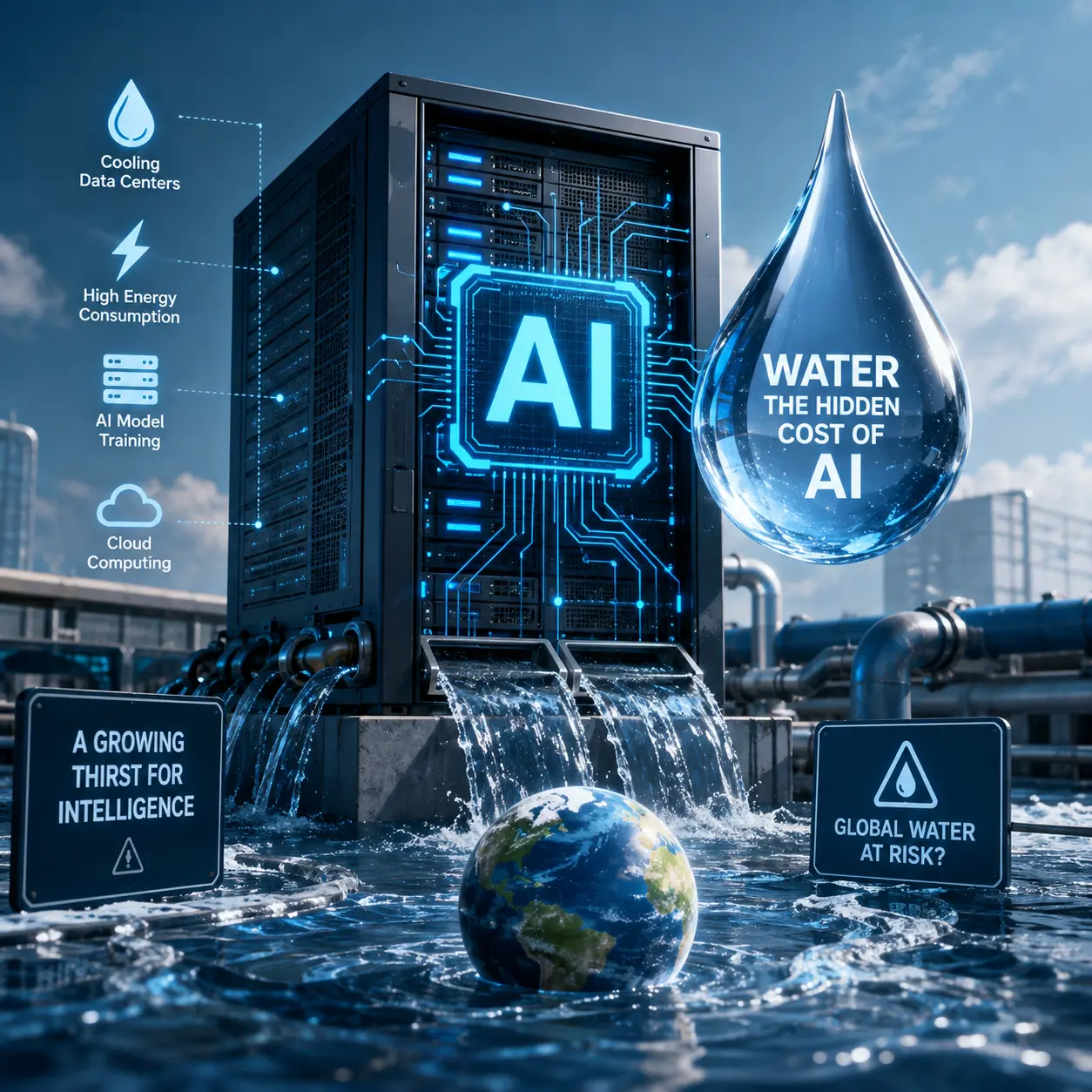
Artificial intelligence is changing our daily lives. Millions of people use AI every single day. However, this powerful technology has a hidden environmental cost. Have you ever wondered why AI uses water?
When we think of AI, we picture invisible digital clouds. We rarely think about the physical machinery behind it. But AI actually lives inside massive physical data centers. These huge buildings consume vast amounts of electricity. They also require millions of gallons of fresh water. In fact, water is a critical resource for AI in 2026.
This reality brings up a very serious question. As the demand for AI grows, its thirst increases too. Is the massive water consumption of AI a warning for humans? Could this amazing technology threaten our global water supply?
In this article, we will explore exactly how AI uses water. We will uncover the latest 2026 data. Finally, we will see what this environmental impact means for humanity.
The Hidden Thirst: How Much Water Does AI Actually Use?
Before we understand why AI needs water, we must check the data. The statistics for 2026 are quite shocking to read.
In recent years, the water footprint of AI has exploded. According to a June 2026 United Nations University report, the numbers are alarming. AI data centers consumed over 264 billion gallons of water recently. By 2030, the water used by AI could be staggering. It might match the basic daily needs of 1.3 billion people.
Let us make this easier to understand for everyday users. Every time you type a prompt into an AI, it uses water. A single simple query uses about one-fifth of a teaspoon. That sounds very small at first. But when you ask 10 to 50 questions, AI consumes half a liter of water.
Now, imagine billions of people asking questions every single day. The total amount of water used is absolutely massive. AI data centers are now using more water than some small countries. This massive scale is exactly why scientists are heavily concerned today.
Why Does AI Need Water to Work?
You might be wondering how software can drink water. The answer lies entirely in the hardware that powers the AI.
AI does not run on thin air or magic. It runs on physical computer servers. These computers use specialized chips called Graphics Processing Units. We usually call them GPUs for short. GPUs are incredibly fast and powerful computing chips. They can process millions of calculations in a single second.
However, all this intense brainpower requires a massive amount of electricity. When GPUs consume electricity, they create extreme heat. If this heat is not removed quickly, the servers will melt. The machines would catch fire, and the AI system would crash completely.
This is exactly where water comes into the picture. Data centers must stay very cool every hour of the day. Cooling systems are not just for human comfort. They are a strict operational requirement for any working AI.
The Role of Data Center Cooling Systems
To manage this extreme heat, data centers use different cooling methods. Water is the most popular choice globally. It is cheap and highly effective at absorbing excess heat.
There are a few main ways AI uses water for cooling. We will explore the most common ones used today.
First, there are evaporative cooling towers. This is the most common method used in 2026. Warm water from the servers is pumped into a tall tower. Outside air is used to evaporate the hot water. As the water turns into vapor, it pulls heat into the atmosphere. This method uses a lot of fresh drinking water. The evaporated water is permanently lost to the outside air.
Second, there are closed-loop liquid cooling systems. In this modern setup, water flows through sealed internal pipes. These pipes sit right next to the hot computer chips. The water absorbs the heat and carries it away safely. Since the pipes are completely sealed, the water is never evaporated. It can be reused continuously. However, these modern systems are very expensive to build.
Direct vs. Indirect Water Consumption
When we talk about AI and water, we must look closely. There are two different ways AI actually consumes water.
First, we have direct water consumption. This is the water used inside the data center for cooling. As mentioned, evaporative cooling towers drink fresh water every minute. They need this constant water flow to keep the servers perfectly chilled.
Second, we have indirect water consumption. This factor is often ignored, but it is deeply important. AI data centers use a massive amount of electricity daily. In 2026, power plants generate this electricity using coal or nuclear energy. These large power plants also need water. They use massive amounts of water to cool their own large generators.
So, an AI data center might use a sealed cooling system. It might have zero direct water loss on site. However, it still uses water indirectly through the power grid. The electricity powering the AI requires water at the power plant. This double impact makes the AI water footprint incredibly large.
Is AI Water Usage a Warning for Humans?
Now we reach the most critical question of all. Is this massive water consumption a real warning for humanity? The short answer is yes.
The world is currently facing a severe global water crisis. Clean drinking water is becoming much harder to find everywhere. In 2026, many regions are experiencing devastating and long droughts. For example, recent reports show 63 percent of the US faces extreme drought conditions.
Despite this global crisis, tech companies build data centers in dry regions. Why do they choose these specific desert locations? Because these dry areas often have cheap land and abundant solar power. States like Arizona have become major hubs for new AI data centers.
This creates a very dangerous conflict for the future. AI data centers are directly competing with local human communities. They are fighting for the exact same limited water supply. Ultimately, AI uses water that humans desperately need to survive.
The Threat to Local Communities and Agriculture
When a data center uses millions of gallons, communities truly suffer. That water is permanently taken away from the local town. It is water that could have been used for healthy drinking. It could have been used for local wildlife or family farming.
Farming requires a lot of water to grow our food. If a data center drains the local reservoir, farmers heavily struggle. They cannot water their vital crops during the hot summer months. This can easily lead to food shortages and higher grocery prices everywhere.
Furthermore, local utility costs are fully expected to rise rapidly. As AI drains local water systems, cities must spend more money. They have to find and clean brand new water sources constantly. These extra financial costs are often passed down to regular citizens. Everyday people end up paying higher monthly water bills.
A digital software tool should not compromise basic human survival resources. This is a massive warning sign for our modern society today.
Pros and Cons of AI Water Usage
It is important to look fairly at both sides of this issue. There are clear pros and cons to AI and water usage.
Let us start with the positive side first. AI can actually help solve some major global water problems. Advanced AI systems can optimize city water grids to prevent pipe leaks. Smart AI tools can also help farmers use less water daily. They predict weather patterns to optimize crop irrigation perfectly. This unique capability saves millions of gallons of water in agriculture.
Now, let us look at the severe negative side. The biggest con is the massive water footprint of AI itself. As we learned, AI uses water at an alarming and rapid rate. Another negative impact is dangerous thermal pollution. Sometimes, data centers pump hot water back into local lakes. This sudden heat can easily kill fish and destroy delicate natural ecosystems.
Finally, the extreme stress on local power and water grids is highly dangerous. The cons currently outweigh the pros in water-scarce regions. Tech companies must definitely find a better balance moving forward.
Future Solutions: Can AI Survive Without Water?
The warning signs are very clear, but there is still some hope. Can AI survive without draining our precious global water supply?
Tech companies are actively looking for new future solutions. Many large corporations have made strong environmental pledges in 2026. Companies like Meta and Amazon promise to become completely water-positive by 2030. This means they firmly plan to restore more water than they use.
One practical solution is using reclaimed wastewater instead of fresh drinking water. Data centers can safely cool servers using recycled dirty water. This protects the clean water meant for human drinking.
Another emerging technology is advanced immersion cooling. In this unique method, servers are completely submerged in a special fluid. This non-conductive fluid absorbs heat perfectly without using any natural water.
Finally, AI is being used to optimize its own software efficiency. AI can rewrite code to require less computing power over time. Less computing power simply means less heat and less water needed. These amazing innovations are crucial for a sustainable technological future.
Conclusion
In conclusion, the relationship between AI and water is highly complex. We now know exactly how and why AI uses water today. High-powered computer servers generate extreme heat that must be cooled constantly.
The latest 2026 data shows an undeniable and massive water footprint. Data centers are rapidly consuming billions of gallons of precious natural resources. This is absolutely a strict warning for humans globally. As global droughts increase, we simply cannot afford to waste clean drinking water.
However, the global tech industry is waking up to this crisis. With new cooling technologies and smart recycling, real change is possible. If we want to enjoy AI safely, we must protect nature first. AI uses water heavily today, but it must learn to save it tomorrow.
Frequently Asked Questions (FAQ)
Why does AI need water to function?
AI runs on powerful physical computers called servers. These servers generate extreme heat when processing heavy digital data. AI needs water to cool these servers down and prevent dangerous fires.
How much water does a single ChatGPT prompt use?
A single AI prompt uses roughly one-fifth of a teaspoon. However, a normal conversation of 10 to 50 questions uses half a liter. This adds up very quickly with billions of daily users.
What is a data center evaporative cooling tower?
It is a massive machine used to cool hot data servers. It pumps hot water in and uses outside air to evaporate it. The evaporation process safely pulls the dangerous heat into the atmosphere.
Is AI secretly stealing human drinking water?
AI is not stealing water secretly, but it is aggressively competing for it. Many data centers are built in dry areas facing severe droughts. They openly use millions of gallons of fresh water that communities need.
Can AI run without water in the near future?
Yes, it is very possible. Tech companies are testing new cooling methods right now. They are using special non-water fluids and advanced air cooling systems. They also plan to use recycled wastewater instead of clean drinking water soon.