
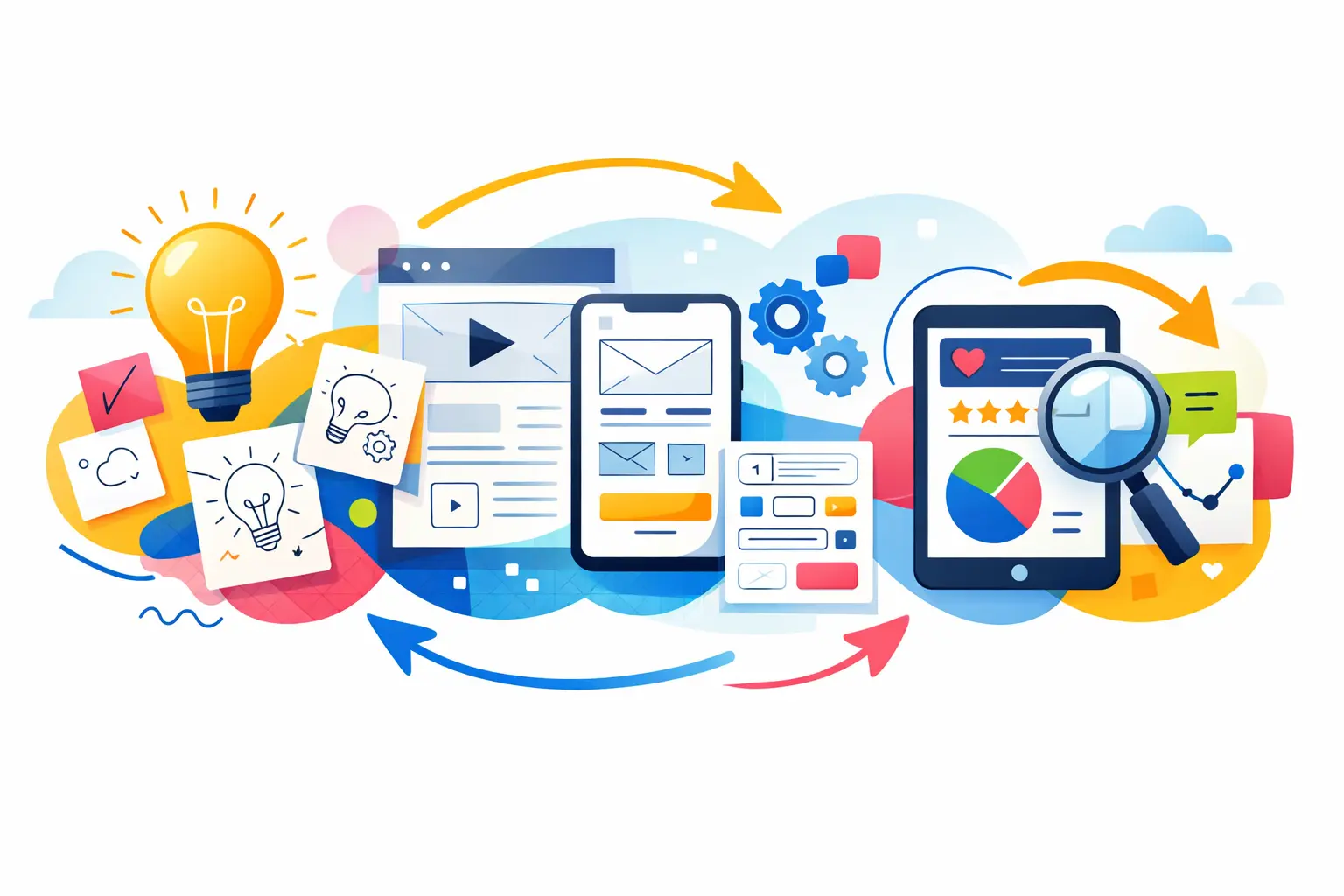
The design thinking process is a strategic, human‑centered framework used to solve complex problems in digital products. It focuses on deeply understanding users through research, then generating ideas, building prototypes, and testing to ensure solutions truly meet user needs. This approach moves teams beyond assumptions and into real insights that create digital products people want to use.
In a world where digital products must surprise and delight users, the design thinking process helps teams innovate faster, reduce risk, and deliver real value. It’s not just about good visuals — it’s about building products that work well, solve users’ problems, and drive business goals.
What Is the Design Thinking Process?
The design thinking process is typically described as a cycle of five core stages:
1. Empathize (Understand Users)
This stage involves deep user research to understand behaviors, needs, goals, and pain points. Methods include interviews, observation, and surveys. By learning what users truly want, teams build empathy — often the foundation of meaningful product design.
2. Define (Clarify the Problem)
Here, teams synthesize user research findings to define the real problem. This phase frames the challenge in a way that sets the right direction for solutions. A clear problem statement keeps the product focused on user needs rather than assumptions.
3. Ideate (Explore Solutions)
In ideation, teams generate a wide range of ideas without judgment. Techniques like brainstorming or sketching help uncover creative pathways before narrowing down to promising solutions.
4. Prototype (Build to Learn)
Prototyping transforms ideas into tangible representations — from sketches and wireframes to digital interfaces. Prototypes let teams test assumptions early and refine designs before costly development.
5. Test (Validate with Real Users)
Testing involves observing real users interacting with prototypes. Feedback reveals usability issues and confirms whether solutions work as intended. Iteration continues until the product aligns with user expectations.
Note: The design thinking process is iterative — teams often cycle back to earlier phases based on new insights.
User Research: The Heart of the Design Thinking Process
User research is one of the most critical elements of the design thinking process because it ensures decisions are data‑driven rather than assumption‑based. Understanding the user:
- Helps uncover real motivations, frustrations, and context of use.
- Improves problem definition and avoids costly missteps later.
- Guides ideation, prototyping, and testing with validated insights.
Research techniques include focus groups, contextual interviews, and usability testing, all contributing to deeper empathy and better product decisions.
Without user research, digital products risk building features that sound good internally but don’t solve real user issues, leading to low engagement or high churn after launch.
Prototyping: Turning Ideas Into Action
Prototyping is an essential phase of the design thinking process and helps teams explore solutions without heavy investment. It’s not a single step — it’s a series of experiments ranging from low‑fidelity sketches to interactive digital models.
Types of Prototyping
- Low‑Fidelity Prototypes: Paper sketches, rough wireframes that allow quick iteration.
- Digital Prototypes: Interactive models using tools like Figma, InVision, or Adobe XD.
- Functional Prototypes: Working models demonstrating key interactions.
Every prototype serves to validate assumptions and shape design decisions before full product development.
Why Prototyping Matters
- Early Validation: Reveals usability issues before launch.
- Team Alignment: Helps engineers, designers, and stakeholders see the same vision.
- Cost Efficiency: Saves money by catching errors early.
Research shows that prototypes tested with real users help teams uncover usability issues early and reduce development time and cost.
Real World Examples: Design Thinking in Digital Products
Airbnb
Airbnb’s early prototype was a simple website that tested whether people would pay for home stays. This prototype shaped their full product development and helped them succeed by iterating based on real user feedback.
Adobe Creative Cloud
Adobe uses rapid prototyping within its design thinking process to refine features based on user feedback, boosting user retention and platform adoption.
These examples show how integrating user research and prototyping within the design thinking process leads to digital products that resonate with real users and drive business outcomes.
Benefits of Using the Design Thinking Process
The design thinking process offers powerful advantages for digital products:
- User Satisfaction: Users feel understood and engaged when products reflect real needs.
- Reduced Risk: Prototyping and testing decrease the chance of building unwanted features.
- Faster Time to Market: Early testing accelerates decision‑making.
- Cross‑Team Collaboration: Diverse teams explore better solutions together.
Challenges and Best Practices
While powerful, the design thinking process isn’t without challenges:
- Time and Resources: Deep user research and multiple prototypes take time.
- Feedback Bias: User feedback sometimes reflects preferences, not real needs.
- Iteration Fatigue: Teams can get stuck in endless cycles without clear goals.
Best Practices
- Prioritize meaningful user research.
- Use rapid prototypes to validate early and often.
- Document findings for team alignment.
- Keep user experience at the center of every stage.
Conclusion
The design thinking process is more than a methodology — it’s a mindset that places users at the center of innovation. By combining user research, prototyping, and iteration, teams consistently build digital products that are usable, valuable, and successful in the market.
If your goal is to create digital products that users love and businesses grow from, mastering the design thinking process is essential. It transforms uncertainty into opportunity and ideas into products that truly matter.