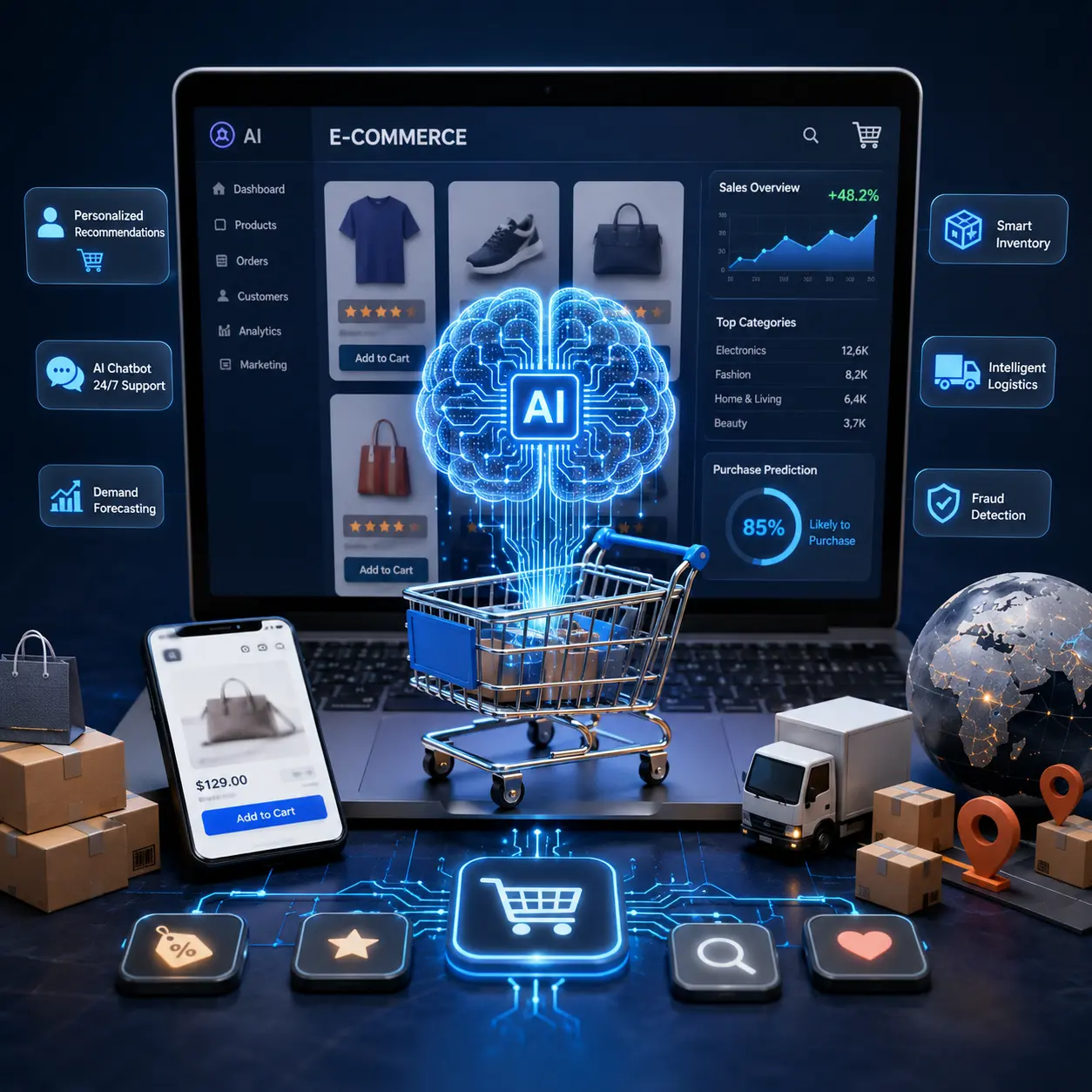
Welcome to the modern era of online shopping. In 2026, the integration of AI in E-Commerce has shifted from an experimental feature to an absolute operational necessity. The digital storefront is evolving rapidly. Businesses are no longer just using artificial intelligence to recommend similar items. They are using it to completely redefine the customer journey.
Whether you are a startup founder or managing a large digital marketplace, understanding AI in E-Commerce is crucial. Technology has moved beyond basic automation. Today, intelligent systems can predict exactly what a buyer wants before they even type a search query. This level of hyper-personalization is setting a new standard for the industry.
In this comprehensive guide, we will explore the latest trends shaping AI in E-Commerce. We will dive deep into how these advanced algorithms work and review practical use cases. By the end of this article, you will know exactly how artificial intelligence can help scale your business, optimize operations, and boost overall customer satisfaction.
Understanding AI in E-Commerce
At its core, AI in E-Commerce refers to the use of artificial intelligence technologies to enhance online retail operations. This includes utilizing machine learning, natural language processing, and deep learning algorithms. These technologies analyze vast amounts of data to make intelligent, real-time decisions.
In previous years, algorithms only followed strict rules. If a customer bought a phone, the system recommended a case. In 2026, AI evaluates hundreds of real-time signals. It considers a buyer’s browsing history, the time of day, location, and inferred intent. This creates a deeply personalized experience tailored to every unique individual.
Furthermore, AI does not just help on the front end of a website. It completely revolutionizes backend operations. From managing supply chains to adjusting pricing on the fly, artificial intelligence acts as a tireless digital manager. It ensures your store runs smoothly around the clock without manual intervention.
The Current Landscape: 2026 AI and E-Commerce Statistics
To truly grasp the impact of AI in E-Commerce, we must look at the data. The statistics for 2026 highlight a massive shift in how retailers and consumers interact. The global market size for these technologies is experiencing unprecedented growth.
The artificial intelligence in E-Commerce market is projected to reach $10.5 billion in 2026. It is growing at a compound annual growth rate of over 15%. This financial surge is driven by consumer demand and competitive pressure. In fact, recent industry reports show that 84% of E-Commerce businesses rank AI as their absolute highest strategic priority.
Consumers are also embracing this technological wave. Approximately 51% of online shoppers now actively use AI tools for their shopping needs. Gen Z leads this trend at 37%, utilizing smart assistants and visual search daily. Furthermore, stores utilizing advanced personalization generate 40% more revenue than those relying on traditional methods.
The Shift to Agentic Commerce in 2026
One of the biggest breakthroughs this year is the rise of agentic commerce. This represents the next major evolution of AI in E-Commerce. Traditional automation simply assisted human workers. Agentic AI actually takes independent action based on user goals.
Agentic systems can make intelligent decisions on behalf of the customer or the merchant. For example, an agentic shopping assistant can research products, compare prices, and execute a purchase with zero clicks required from the buyer. This zero-click buying era is completely transforming conversion funnels.
For store owners, agentic AI takes over complex administrative tasks. It can autonomously reorder inventory when stock is low, route shipments around weather delays, and adjust product bundles dynamically. This reduces manual workload and allows business owners to focus purely on high-level strategy and growth.
7 Game-Changing Use Cases for AI in E-Commerce
The theoretical benefits of technology are great, but practical application is what drives revenue. Let us explore the most powerful use cases of AI in E-Commerce happening right now.
1. Hyper-Personalized Product Recommendations
Modern consumers hate generic shopping experiences. Around 91% of buyers prefer brands that offer personalized recommendations. AI excels at processing behavioral data to surface exactly what a customer desires. Instead of showing broad categories, AI in E-Commerce curates unique homepage carousels for every single visitor.
These advanced product recommendations can increase overall revenue by up to 300%. The AI understands the nuanced relationships between items. It knows that a buyer looking at a specific winter coat might also want thermal gloves based on regional weather data. This level of hyper-personalization dramatically increases cart sizes.
2. Conversational AI and Smart Shopping Assistants
The era of frustrating, scripted chatbots is officially over. Today, AI in E-Commerce utilizes natural language processing to deliver genuine conversational commerce. These smart assistants remember past interactions, understand context, and speak naturally to the user.
This translates to massive sales improvements. E-Commerce platforms using advanced AI chat experience up to 4 times higher conversion rates. Furthermore, these intelligent assistants resolve 93% of customer service inquiries without any human intervention. They even recover 35% of abandoned carts through proactive, helpful messaging.
3. Dynamic Pricing and Promotions
Pricing products statically leaves money on the table. AI allows for intelligent dynamic pricing. The software monitors competitor prices, real-time market demand, and current inventory levels to adjust your prices automatically. This ensures you remain competitive while protecting your profit margins.
Unlike older systems that relied on heavy discounting, 2026 AI balances immediate sales with long-term profitability. It targets specific promotions to buyers who need a slight nudge, rather than offering site-wide sales that erode your gross margin unnecessarily.
4. Smart Logistics and Supply Chain Management
Backend operations are just as critical as the storefront. AI in E-Commerce is revolutionizing how products move from the warehouse to the customer. Predictive demand modeling allows retailers to forecast exactly what items will sell in specific regions.
By anticipating demand accurately, businesses can reduce total inventory levels by up to 20%. Furthermore, intelligent routing and self-correcting networks lower logistics costs by 15%. This is vital in an industry where last-mile delivery often accounts for more than half of total shipping expenses.
5. Visual and Voice Search Discoverability
Text-based search is no longer the only way consumers find products. Visual search has increased by 70% globally. Shoppers can simply point their smartphone camera at an item they like in the real world. The AI instantly scans the E-Commerce store to find exact matches or similar products.
Voice search is equally important. Hands-free technology allows users to ask their smart speakers to find specific products or reorder household essentials. Optimizing your store for these AI-driven search methods is crucial for capturing modern consumer traffic.
6. Advanced Fraud Detection and Prevention
Security is paramount in digital retail. In the past, aggressive fraud filters often blocked legitimate buyers, ruining the customer experience. Today, AI in E-Commerce strikes the perfect balance. It utilizes deep learning to identify subtle, complex patterns of fraudulent behavior in real time.
The AI assesses hundreds of risk factors instantly during checkout. It approves valid transactions without adding extra friction while blocking malicious actors effectively. This reduces costly chargebacks and maintains a smooth purchasing journey for honest shoppers.
7. Generative AI for Content Creation
Writing thousands of unique product descriptions is exhausting. Generative AI handles this effortlessly. It can write compelling, SEO-optimized product copy in your specific brand voice within seconds. It also helps generate stunning product images and marketing graphics automatically.
By automating the heavy lifting of content creation, marketing teams can publish new product listings much faster. This ensures the digital catalog is always fresh, engaging, and ready to convert incoming traffic into loyal customers.
Real-World Examples of AI in E-Commerce Success
Many top brands are already reaping the rewards of these technologies. Let us look at how AI is actively deployed in the current market.
Major apparel brands are using advanced cross-selling modules at checkout. The AI analyzes the items currently in a shopper’s cart and suggests perfect add-ons that fit the same package. This subtle recommendation strategy boosts average order value without slowing down the checkout process.
Another great example involves conversational commerce integrations. Platforms are allowing users to complete purchases directly within AI interfaces like ChatGPT. A customer can ask for gift ideas, view the suggestions, and buy the product without ever leaving the chat window. This seamless integration proves how powerful AI in E-Commerce has become.
The Pros and Cons of AI in E-Commerce
While the benefits are clear, adopting new technology always comes with challenges. It is important to weigh both sides before fully integrating these systems into your business model.
- Pro: Increased Customer Lifetime Value. Brands that successfully integrate AI see up to a 30% increase in Customer Lifetime Value. Personalized experiences keep shoppers coming back.
- Pro: 24/7 Operational Efficiency. AI never sleeps. It handles customer support, inventory management, and pricing optimizations around the clock, drastically reducing annual operating costs.
- Pro: Data-Driven Decision Making. AI removes the guesswork from business strategy. It analyzes massive datasets to provide actionable insights that human managers would likely miss.
- Con: Technical Integration Hurdles. Many older businesses struggle with technical debt. Integrating modern AI into legacy systems can be costly and requires specialized technical knowledge.
- Con: Consumer Trust Issues. While adoption is high, roughly 30% of older consumers remain skeptical about AI handling their payment information. Transparency is required to build trust.
- Con: Over-Reliance on Automation. Relying entirely on algorithms without human oversight can lead to issues if the AI encounters unprecedented market shocks or unusual data anomalies.
Frequently Asked Questions (FAQ)
What is AI in E-Commerce?
AI in E-Commerce is the application of machine learning, natural language processing, and automation to online retail. It is used to personalize shopping experiences, manage inventory, optimize pricing, and provide intelligent customer service.
How does AI improve the customer shopping experience?
It improves the experience by understanding individual user intent. AI provides tailored product recommendations, faster visual and voice search options, and instant customer support through smart conversational agents.
Will AI replace human jobs in online retail?
AI is designed to augment human work, not entirely replace it. While it automates repetitive tasks like data entry and basic customer support, it frees up human workers to focus on creative strategy, brand building, and complex problem-solving.
What is Agentic Commerce?
Agentic commerce is a major 2026 trend where AI acts independently to achieve goals. Instead of just suggesting actions to a human, an agentic AI can automatically reorder stock, adjust prices, or even purchase items for a user based on predefined rules.
Is AI safe to use for processing online payments?
Yes, AI is highly secure. In fact, artificial intelligence is primarily used in the payment sector to detect and prevent complex fraud in real time. However, E-Commerce brands must always ensure their AI tools comply with strict data privacy regulations.
Conclusion
The digital retail landscape is moving at breakneck speed. As we navigate through 2026, it is abundantly clear that AI in E-Commerce is the foundation of future growth. From hyper-personalized product recommendations to autonomous supply chain management, artificial intelligence touches every single aspect of the modern online store.
Businesses that embrace these intelligent systems are seeing massive returns. They boast higher conversion rates, lower operational costs, and unparalleled customer loyalty. Those who ignore this technological shift risk falling behind in an increasingly competitive global market.
Now is the perfect time to audit your current operations. Start small by introducing smart chat assistants or predictive analytics, and gradually scale your tech stack. By fully leveraging AI in E-Commerce, you can build a resilient, highly profitable business that continuously exceeds customer expectations for years to come.