The State of Artificial Intelligence in 2026
The artificial intelligence landscape has shifted massively in 2026. Companies face a critical technology infrastructure decision today. The core debate is own AI vs LLM API. Each path offers unique benefits and serious technical drawbacks. We will explore the complete 2026 market dynamics carefully. You need the absolute right architecture for your business. The wrong choice can cost millions of wasted dollars. We will break down costs, privacy, and performance metrics. This guide will help you navigate enterprise AI safely. You will learn how to scale your applications intelligently.
Beyond Simple Chatbots
The market has evolved beyond simple experimental web chatbots. Large language models power complex enterprise operations daily now. We now see advanced models like OpenAI GPT-5.4. Anthropic released the highly capable Claude Opus 4.6 recently. Open-source models like Llama 4 are also incredibly powerful. DeepSeek has drastically reduced pricing across the entire board. Businesses are no longer just experimenting with generative AI. They are deploying AI into core production systems everywhere. This requires high reliability and strict corporate data governance. The choice of architecture dictates your long-term market success. Vendor lock-in is a massive concern for modern executives. You must evaluate your specific workload requirements very carefully.
What Does Building Custom AI Mean?
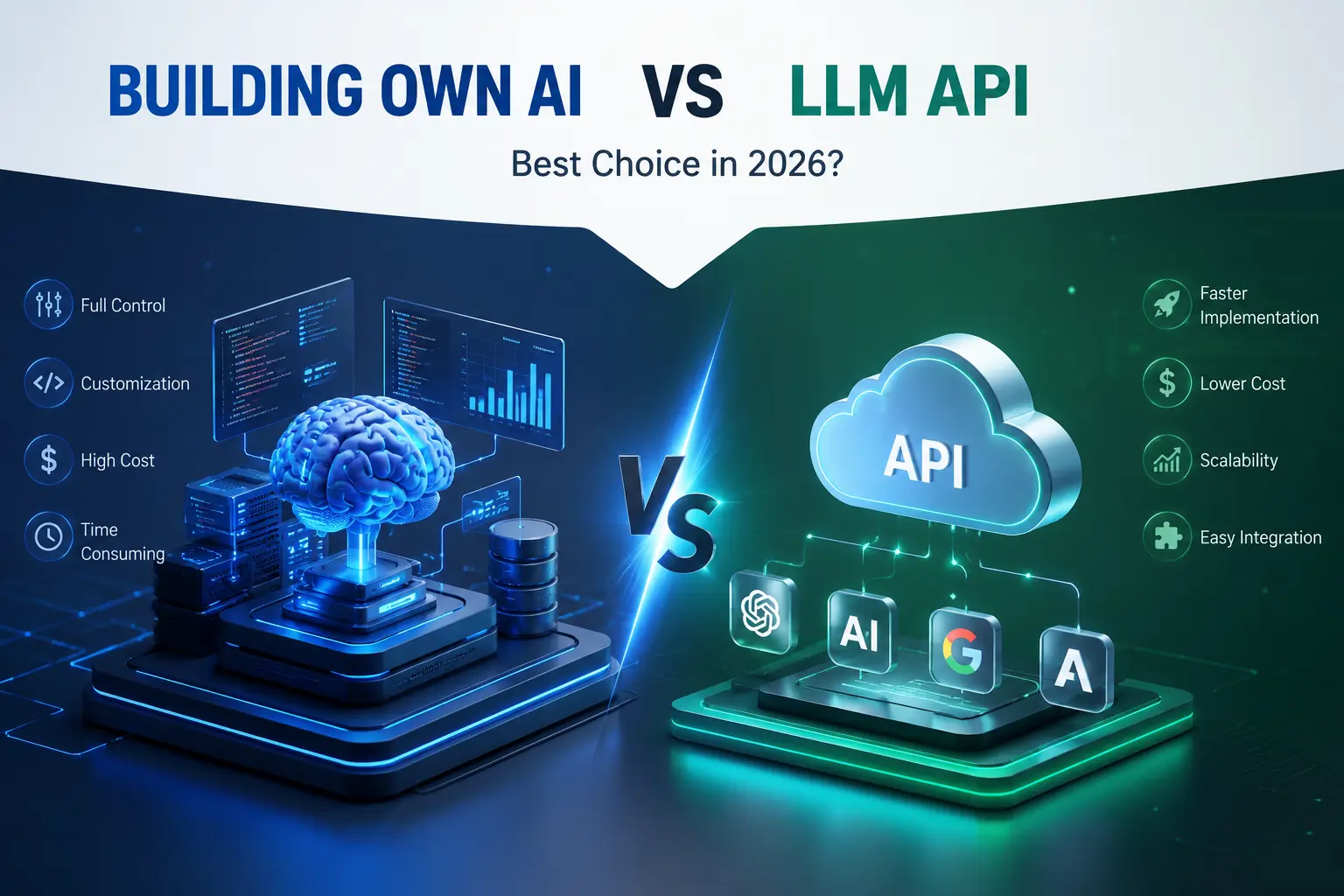
Building custom AI does not mean starting from scratch. It involves hosting open-weight models on your own infrastructure. You can use powerful platforms like Llama 4 easily. You adapt these models to your specific business workflows. This process is called fine-tuning or retrieval-augmented generation. The artificial intelligence runs entirely within your secure network. No corporate data ever leaves your internal company firewalls. You control the hardware, the weights, and the output. It requires hiring specialized machine learning engineers for maintenance. You also need access to expensive GPU compute clusters. This approach is highly customized for your specific enterprise. It understands how your unique business actually operates daily.
Pros of Custom Enterprise AI
There are many distinct advantages to self-hosted AI models. Data privacy is the most significant benefit available here. Your proprietary data never touches a public cloud server. This is vital for healthcare, finance, and defense sectors. You have total control over the model’s daily behavior. You avoid unexpected provider updates that break your applications. You also bypass expensive per-token API billing cycles completely. Inference costs drop dramatically at very high generation volume. You own the intellectual property of the fine-tuned model. It understands your specific corporate terminology and acronyms perfectly. This leads to highly accurate, domain-specific business insights constantly. Your custom model becomes a unique strategic business asset.
Cons of Self-Hosted Models
Building your own AI is not a perfectly easy task. The upfront infrastructure costs are incredibly high and prohibitive. You must purchase or lease expensive GPU server racks. Maintaining this hardware requires a dedicated specialized engineering team. Open-source models can sometimes lag behind commercial frontier models. Training and fine-tuning take considerable time, money, and effort. You are entirely responsible for applying all security patches. System downtime is entirely your responsibility to fix quickly. Scaling up rapidly during traffic spikes is very difficult. It diverts valuable resources away from your core product. Many companies drastically underestimate the total cost of ownership. You must possess significant technical maturity to succeed here.
What Are LLM APIs?
LLM APIs offer a fundamentally different path to AI. You rent access to frontier models via cloud endpoints. Top providers include OpenAI, Anthropic, Google, and emerging xAI. You simply send a text prompt to their external servers. The provider processes the request and sends text back. You pay a small fee per million tokens processed. There is absolutely zero hardware infrastructure for you to manage. You can start building AI applications in five minutes. This approach democratizes access to world-class machine intelligence globally. It relies on the standard pay-as-you-go cloud computing model. Developers can focus entirely on the core user experience. You do not need to hire expensive machine learning experts.
Pros of Using LLM APIs
Speed to market is the biggest advantage of APIs. You bypass months of complicated infrastructure setup completely today. You get instant access to models like Gemini 3.1 Pro. These frontier models possess unparalleled reasoning and coding capabilities. Providers handle all the scaling and load balancing magically. You always have access to the absolute latest model versions. The initial financial investment is practically zero dollars upfront. You only pay for the exact compute power you consume. Extensive documentation and global community support are readily available. Third-party software integrations are built primarily for these APIs. You can test different business ideas with minimal financial risk. It is the ultimate tool for rapid agile prototyping.
Cons of Relying on APIs
Relying on external APIs carries significant hidden business risks. Data privacy is a major concern for highly regulated industries. You are constantly sending sensitive data to third-party servers. API pricing can escalate rapidly at high production volumes. A single rogue script can drain your entire monthly budget. You are subject to the provider’s unexpected service outages. In 2025, every major provider experienced significant platform downtime. You have no control over arbitrary model deprecation schedules. Providers can change pricing or core capabilities without warning. Vendor lock-in becomes a serious long-term strategic enterprise threat. You are essentially renting your core business intelligence daily. Switching providers later requires rewriting a significant amount of code.
Analyzing the 2026 Cost Comparison
The financial math has changed significantly in the year 2026. Let us thoroughly compare own AI vs LLM API costs. API costs are highly variable and completely token-dependent today. GPT-5.2 charges varying rates for input and output tokens. DeepSeek offers compelling API pricing at a steep market discount. At very low volumes, commercial APIs are vastly cheaper. Building custom AI requires massive heavy upfront capital expenditure. You must aggressively pay for hardware, electricity, and engineering talent. However, the financial cost curves cross at high inference volumes. Generating millions of tokens daily makes self-hosting significantly cheaper. You must model your specific projected token usage very accurately. Calculate the precise breakeven point for your specific enterprise workload.
Performance and Model Capabilities
Frontier API models generally lead in raw logical reasoning tasks. Claude Opus 4.6 heavily dominates complex coding and agentic workflows. GPT-5.4 excels at broad capabilities and extensive tool integration. However, the historical performance gap has closed significantly lately. Open-source models like Llama 4 easily rival older frontier models. DeepSeek completely matches top tier performance for math and coding. Custom models truly excel at highly specific niche domain tasks. A fine-tuned Llama model will beat generic GPT very often. It knows your internal acronyms and complex data structures perfectly. You must benchmark models directly against your specific daily workflows. Generic internet benchmarks do not reflect actual real enterprise value. Performance depends entirely on your exact required business use case.
Data Privacy and Security Concerns
Security remains the ultimate deciding factor for many large enterprises. Regulated industries cannot use public LLM APIs legally or safely. HIPAA and GDPR compliance severely require strict geographical data boundaries. A custom enterprise AI completely solves these complex compliance issues. Your data remains completely segregated and strictly audited at all times. API providers do offer enterprise tiers with zero data retention. However, trust in these corporate promises varies among corporate leaders. External data transit still poses a very real theoretical security risk. Self-hosting completely eliminates the data transit vector entirely today. You must consult your legal compliance team before deciding anything. Security architecture perfectly dictates your ultimate AI deployment production strategy. Do not compromise on your critical enterprise data security ever.
The Rise of Multi-Model Strategies
Most successful enterprises no longer choose just one single path. The hybrid multi-model approach dominates the current 2026 enterprise landscape. Companies wisely deploy two to three different models simultaneously today. They utilize a powerful LLM API gateway for smart request routing. API gateways successfully cut inference costs by up to sixty percent. Simple text classification tasks strictly route to cheap open-source models. Complex reasoning tasks automatically route to expensive Claude or GPT. This optimization perfectly balances financial cost, operational speed, and privacy. Gateways beautifully provide unified authentication and automatic failover redundancy systems. If OpenAI suddenly goes down, traffic safely routes to Anthropic automatically. This resilient architecture brilliantly provides the ultimate robust enterprise resilience. You avoid vendor lock-in while successfully maximizing overall AI performance.
Choosing Between Open and Closed Source Gateways
Open-source inference providers offer a brilliant middle ground today. Companies like Groq beautifully provide blazing fast AI inference speeds. You get open weights without painfully managing the actual hardware. This perfectly blends API convenience with open-source AI model freedom. It is a highly compelling alternative to major expensive frontier APIs. You strictly still face data residency concerns with this specific method. However, the financial cost per token is dramatically lower here. DeepSeek has aggressively pushed the entire market toward much lower prices. Closed source models brilliantly maintain an edge in rich multimodal capabilities. Gemini 3.1 Pro magically processes text, image, and video perfectly seamlessly. Your final choice depends strictly on your exact required business capabilities. Evaluate these exciting inference providers carefully for your specific AI stack.
Operational Challenges and Maintenance
Running custom AI requires constant vigilant operational maintenance always. You must constantly monitor model drift and sudden performance degradation continually. Retraining aging models takes significant time and massive computing resources. APIs beautifully abstract all this complex maintenance away from you completely. The external provider flawlessly handles model weights, fast servers, and uptime. But sudden API updates can easily break your carefully crafted prompts. You must strictly maintain strong evaluation software pipelines for both paths. Automated testing is absolutely mandatory for long-term enterprise AI success. You need to clearly know when AI accuracy drops unexpectedly quickly. Both strategic choices essentially require significant ongoing operational software management. There is absolutely no fully automated set and forget AI solution. Your dedicated engineering team must remain highly vigilant at all times.
Final Verdict: Which Should You Choose?
The final decision depends entirely on your specific enterprise context. Use LLM APIs primarily for rapid software prototyping and general tasks. They are absolutely perfect for agile startups and small internal tools. APIs effortlessly offer the fastest path to actual tangible business value. Choose a custom AI strictly for highly sensitive corporate data workloads. Self-hosting is completely mandatory for strict regulatory compliance environments today. Build your own models if AI is your main core product. Consider a smart hybrid routing approach for the absolute best results. Evaluate own AI vs LLM API continuously as technology markets shift. The dynamic 2026 AI landscape strictly demands flexibility and smart architecture. Start small, measure everything carefully, and scale your intelligent AI confidently. Make the right choice today to secure your future business success.