Agentic AI is no longer a futuristic concept sitting in research labs. In 2026, it is one of the most talked-about shifts in the entire technology world. Whether you run a small business, work in tech, or are simply curious about where artificial intelligence is heading, understanding what agentic AI means — and how AI agents work — is genuinely important. This guide breaks everything down in plain language. You will learn what are AI agents, how they think and act, what tools power them, and why the numbers around autonomous AI systems in 2026 are turning heads across every major industry.
What Is Agentic AI? A Clear, Simple Definition
Agentic AI refers to AI systems that can take autonomous actions to achieve a goal — without needing a human to guide every single step. Unlike a regular chatbot that just responds to questions, agentic AI can plan, decide, use tools, and execute tasks end-to-end.
Think of it this way. A traditional AI answers your question. An agentic AI goes and actually does the job for you.
The word “agentic” comes from the idea of having “agency” — the ability to act independently and make decisions. So when we talk about agentic AI, we are talking about AI that behaves more like a capable digital worker than a simple question-answering machine.
Google Cloud describes an agentic AI system as one that goes beyond chatbots and implements necessary actions involving reasoning, planning, and memory. That is a key distinction. Agentic AI thinks before it acts, and it keeps working until the task is done.
What Are AI Agents? The Building Blocks Explained
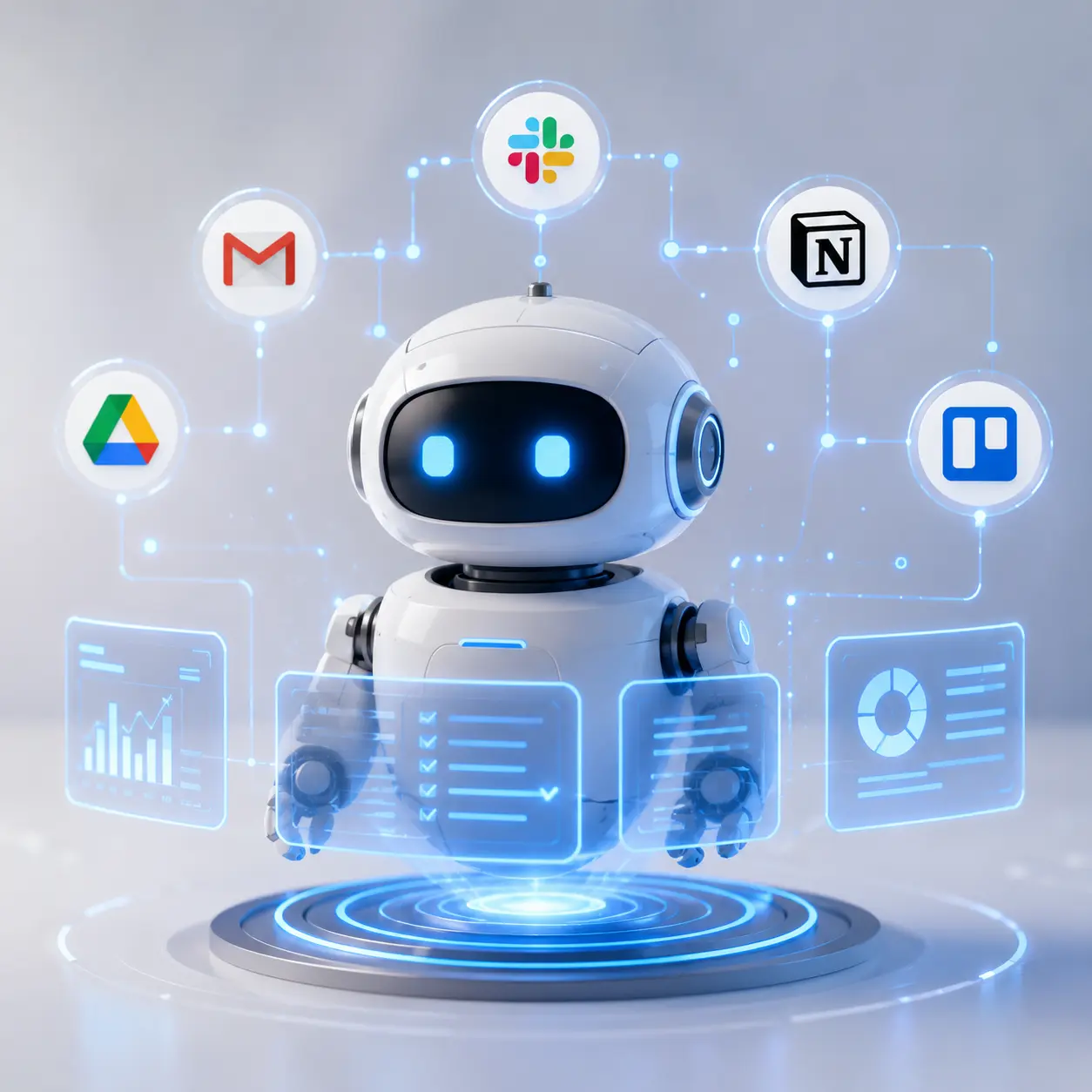
So what are AI agents specifically? An AI agent is a software system powered by a large language model (LLM) that can perceive its environment, make decisions, and take actions using external tools — all without a human telling it what to do at each step.
Here is what makes AI agents different from older AI tools:
- They have goals, not just prompts. You give them an objective and they figure out how to reach it.
- They use tools. AI agents can browse the web, write and run code, send emails, query databases, and more.
- They have memory. They remember past interactions and use that context in future decisions.
- They can adapt. If something fails, AI agents adjust their approach and try again.
Understanding what are AI agents is the foundation of understanding agentic AI as a whole. Every agentic system is built around one or more of these goal-driven, tool-using, memory-enabled agents.
How AI Agents Work: The Core Mechanics
Knowing how AI agents work is essential if you want to understand why they are so powerful. The process is more sophisticated than most people expect. Let us break it down step by step.
Step 1 — Receiving the Goal
The agent receives a high-level instruction. For example: “Research our top five competitors and write a summary report.” This is the trigger. From here, the agent takes over.
Step 2 — Planning the Approach
The agent breaks the big goal into smaller subtasks. It decides which tools it needs, in what order, and how to handle possible failures. This planning step is what separates agentic AI from simple automation.
Step 3 — Acting with Tools
The agent executes each subtask using tool-calling AI capabilities. It might search the web, extract data from documents, run code, or call an API. These tool calls happen autonomously, without waiting for human input.
Step 4 — Observing Results
After each action, the agent checks whether the result matches what it expected. If something went wrong, it adjusts its plan. This self-correction loop is what makes autonomous AI systems in 2026 so much more reliable than earlier AI tools.
Step 5 — Delivering the Output
Once all subtasks are complete, the agent delivers the final result. For our example, that means a finished competitor analysis report — produced entirely without human hand-holding.
The ReAct Framework: The Logic Loop Behind the Action
One of the most important ideas behind how AI agents work is the ReAct framework. ReAct stands for Reason + Act. It is a design pattern that tells the agent to think before it acts, then act, then observe the result, then think again.
The ReAct framework creates a continuous loop: Reason → Act → Observe → Reason again. This cycle keeps repeating until the task is done or the agent determines it cannot proceed. Most modern AI agent frameworks, including LangChain and CrewAI, are built around this ReAct-style logic.
The power of the ReAct framework is that it gives agents the ability to self-correct. They do not blindly follow a script. They adapt in real time based on what they see happening.
LLM Orchestration: The Coordinator Role
In complex agentic systems, LLM orchestration is what keeps everything in order. LLM orchestration refers to the process of managing multiple AI components — models, tools, memory systems, and other agents — so they work together smoothly toward a shared goal.
Think of LLM orchestration like a conductor leading an orchestra. The conductor does not play every instrument. Instead, it coordinates when each one plays, how loud, and in what sequence. In agentic AI, the orchestrator layer decides which agent does what, in what order, and how outputs get passed along the workflow.
Frameworks like LangChain, LangGraph, and CrewAI are essentially LLM orchestration systems. They handle the coordination logic so developers can focus on building the actual tasks they want agents to perform.
Tool-Calling AI: How Agents Reach the Outside World
Tool-calling AI is the mechanism that lets agents interact with real-world systems. A tool, in this context, is any external capability the agent can invoke — a web search, a code executor, a database query, an email sender, a calendar, or a payment API.
Without tool-calling AI, an agent would be limited to whatever knowledge it already has. With tool calling, it becomes a capable worker that can pull fresh information, perform calculations, file documents, and interact with software systems — all on its own.
By late 2025, there were already more than 10,000 public MCP (Model Context Protocol) servers deployed, according to Salesforce. MCP is the emerging standard protocol that allows agents to call tools across different vendors without custom integration work for each one. This is making tool-calling AI faster to deploy and more reliable in production.
Types of AI Agents You Should Know About
Not every AI agent is the same. There are several different types, each suited to different tasks. Here is a quick overview:
- Reactive Agents — Respond directly to inputs with no memory of past events. Best for simple, repetitive tasks.
- Deliberative Agents — Build an internal model of the world and plan actions based on that model. More powerful for complex goals.
- Learning Agents — Improve over time by learning from past experiences. Used in recommendation systems and adaptive workflows.
- Goal-Based Agents — Act specifically to achieve a defined goal. Most modern agentic AI systems fall into this category.
- Utility-Based Agents — Choose actions that maximize a defined measure of success. Used in optimization-heavy scenarios like logistics and pricing.
In practice, most production agentic AI deployments in 2026 combine elements of deliberative, learning, and goal-based agents together — especially when using multi-agent AI systems.
Multi-Agent AI Systems: When Agents Work as a Team
One of the biggest advances in agentic AI right now is the shift toward multi-agent AI systems. Rather than relying on one agent to do everything, multi-agent AI systems use teams of specialized agents that each handle one part of a larger workflow.
Here is a real example of how multi-agent AI systems work in practice. Imagine an e-commerce company running an inventory pipeline:
- An inventory agent detects that a product is running low on stock.
- It notifies a procurement agent, which contacts the supplier.
- The supplier agent confirms availability and places an order.
- A logistics agent then schedules delivery and updates the warehouse system.
No single agent handles the entire process. Multi-agent AI systems split the work so each agent can be an expert in its domain. The result is faster execution, fewer errors, and greater scalability.
Gartner reported a 1,445% surge in multi-agent system inquiries between Q1 2024 and Q2 2025, signaling just how quickly this approach is becoming the default architecture for enterprise agentic AI.
Multi-agent AI systems are especially powerful when combined with LLM orchestration, because the orchestrator can manage agent-to-agent communication, delegate tasks dynamically, and ensure no steps get dropped.
Key Frameworks Powering Agentic AI in 2026
To build autonomous AI systems, developers rely on frameworks that handle the heavy lifting of memory, tool integration, and agent coordination. Here are the major frameworks shaping agentic AI in 2026.
LangChain and LangGraph
LangChain is the most widely used open-source framework for building LLM-powered applications, including AI agents. It provides a modular toolkit with memory support, tool integrations, and chains that developers can link together to build complex workflows. LangChain has over 126,000 GitHub stars and 47 million+ PyPI downloads.
Its graph-based extension, LangGraph, has become the default runtime for LangChain agents in production. LangGraph surpassed CrewAI in GitHub stars in early 2026 and led production deployments with a 40% edge over competing frameworks by March 2026. Its graph model gives developers precise control over state, branching logic, and error recovery — ideal for enterprise agentic AI workflows.
CrewAI
CrewAI takes a different and more accessible approach. It models multi-agent AI systems as human teams, where each agent has a defined role, a goal, and a backstory. Developers can build functional multi-agent workflows in under 30 minutes using plain English-style configuration.
CrewAI is gaining serious traction. It has over 44,000 GitHub stars and sees adoption among 60% or more of Fortune 500 companies for agent prototyping and automation workflows. CrewAI is the recommended entry point for businesses that want to try agentic AI without a large engineering team.
AutoGPT
AutoGPT was the framework that first showed the world what autonomous AI agents could do. It pioneered the idea of giving an AI a goal and letting it break that goal into subtasks, execute them, and evaluate the results — all without human intervention. With over 167,000 GitHub stars, AutoGPT remains one of the most recognized names in agentic AI and continues to be widely used for long-running autonomous workflows.
Microsoft AutoGen
AutoGen models agent collaboration as a dynamic conversation. Agents exchange messages, delegate tasks, and reach decisions through structured dialogue. It is particularly strong for research automation and scenarios where agents need to debate or negotiate before taking action.
Real-World AI Agent Examples in 2026
The best way to understand agentic AI is through AI agent examples from the real world. Here are some of the most compelling cases happening right now:
- Customer Service — AI agents autonomously handle support tickets, escalate complex issues, and resolve common queries without a human agent. Gartner projects that agentic AI will resolve 80% of common customer service issues without human intervention by 2029.
- Healthcare Monitoring — Autonomous AI systems track patient vitals, flag early warning signs, and notify medical staff. Four in ten healthcare executives already use AI for inpatient monitoring. AI applications in healthcare could generate up to $150 billion in annual savings by 2026.
- Software Development — Coding agents plan, write, test, and debug code. They collaborate in multi-agent AI systems where a planner agent, a coder agent, and a reviewer agent each handle one phase of the development cycle.
- Supply Chain and Logistics — Multi-agent AI systems monitor inventory, interact with suppliers, optimize delivery routes, and trigger procurement workflows — all within a fully autonomous loop.
- Content and Marketing — CrewAI-based teams of researcher agents, writer agents, and editor agents produce full content pipelines with minimal human direction.
- Legal and Compliance — Platforms like Legora use agentic workflows throughout their legal technology platform to automate document review, compliance checking, and legal research.
These AI agent examples are not pilots or prototypes. They are live production systems running in major organizations right now in 2026.
Agentic AI by the Numbers: Key 2026 Statistics
The data behind agentic AI in 2026 is striking. Here are the most important statistics that show how fast this space is moving:
- The global agentic AI market is projected to reach USD 10.8 billion in 2026, up from $7.6 billion in 2025 — outpacing early cloud adoption rates.
- The market is expected to surpass $52 billion by 2030.
- 40% of enterprise applications will include task-specific AI agents by the end of 2026, up from less than 5% in early 2025 (Gartner).
- Only 17% of organizations have deployed AI agents so far, yet more than 60% plan to within two years — the most aggressive adoption curve among all emerging technologies (Gartner 2026 Hype Cycle).
- 70% of companies in North America are already using agentic AI in some form.
- 93% of business leaders believe organizations that successfully scale AI agents in the next 12 months will gain a competitive advantage (Capgemini).
- Organizations using autonomous AI systems report a 34% productivity increase among workers.
- Agentic tools reduce trip-planning time from 38.5 minutes to just 9.2 minutes — a 76% time saving.
- Suzano, the world’s largest pulp manufacturer, deployed a Google Cloud AI agent that reduced query handling time by 95% for 50,000 employees.
Benefits of Agentic AI for Businesses
Why are so many organizations rushing to adopt agentic AI? The benefits are hard to ignore. Here are the most impactful advantages that autonomous AI systems offer in 2026:
- Massive time savings — Autonomous workflows handle tasks that used to take hours or days in a fraction of the time.
- 24/7 operation — Unlike human workers, AI agents never need to sleep, take breaks, or go on vacation.
- Scalability — Multi-agent AI systems can scale up instantly to handle increased workloads without new hires.
- Consistency — Agents follow defined processes every single time, reducing human error.
- Cross-system coordination — Agentic AI connects different software systems, databases, and APIs in ways that were previously too complex to automate.
- Decision-making support — Agentic AI can analyze data and provide recommendations at a speed and depth no human team can match.
Challenges and Risks to Keep in Mind
For all its promise, agentic AI also comes with real challenges. Understanding these is just as important as knowing the benefits.
- Reliability in production — Many organizations are still struggling to move from pilot deployments to full production. Over 40% of agentic AI projects may fail by 2027 due to execution challenges.
- Governance and oversight — As agents become more autonomous, questions about accountability, control, and ethics become more pressing. The 2026 Gartner Hype Cycle highlights governance as a critical emerging concern.
- Security risks — Tool-calling AI introduces new attack surfaces, including “tool poisoning” attacks where malicious systems inject harmful instructions into agent behavior.
- Cost management — Multi-agent AI systems can be expensive to run. A complex 20-step agentic task can cost between $1 and $5 per execution depending on the models used.
- Trust and transparency — Organizations need clear audit trails to understand what decisions agents made and why. This is where LLM orchestration platforms with built-in logging become essential.
The Future of Autonomous AI Systems Beyond 2026
Agentic AI is not slowing down. The trajectory of autonomous AI systems points toward a future where AI agents are not just tools — they are colleagues, participants, and even decision-makers in organizational workflows.
By 2028, AI agents are projected to make 15% of daily work decisions, up from virtually zero in 2024. Meanwhile, 33% of enterprise software will include agentic AI capabilities by 2028, compared to less than 1% just a few years ago.
The next frontier involves agentic commerce, where agents negotiate contracts and make purchases autonomously. It also includes guardian agents — supervisory AI agents that monitor other agents for policy violations and ensure ethical behavior. And it includes deeper integration with IoT devices, where agentic AI will coordinate physical systems like robotics, smart buildings, and autonomous vehicles.
What is clear is that the organizations investing in agentic AI architecture, multi-agent AI systems, and LLM orchestration today are the ones that will lead in this next chapter of technology.
Conclusion
Agentic AI has moved from theory to business reality in 2026. Understanding what are AI agents, how AI agents work through frameworks like the ReAct framework, and how multi-agent AI systems coordinate complex workflows is no longer optional knowledge for anyone involved in technology, operations, or strategy. From LangChain and CrewAI to AutoGPT and LLM orchestration platforms, the tools powering autonomous AI systems are mature, accessible, and delivering real results. The statistics speak for themselves — a $10.8 billion market, 40% enterprise app adoption on the horizon, and 93% of business leaders betting their competitive future on it. Agentic AI is not coming. It is already here, and it is already working. The only question now is whether you will be part of it.