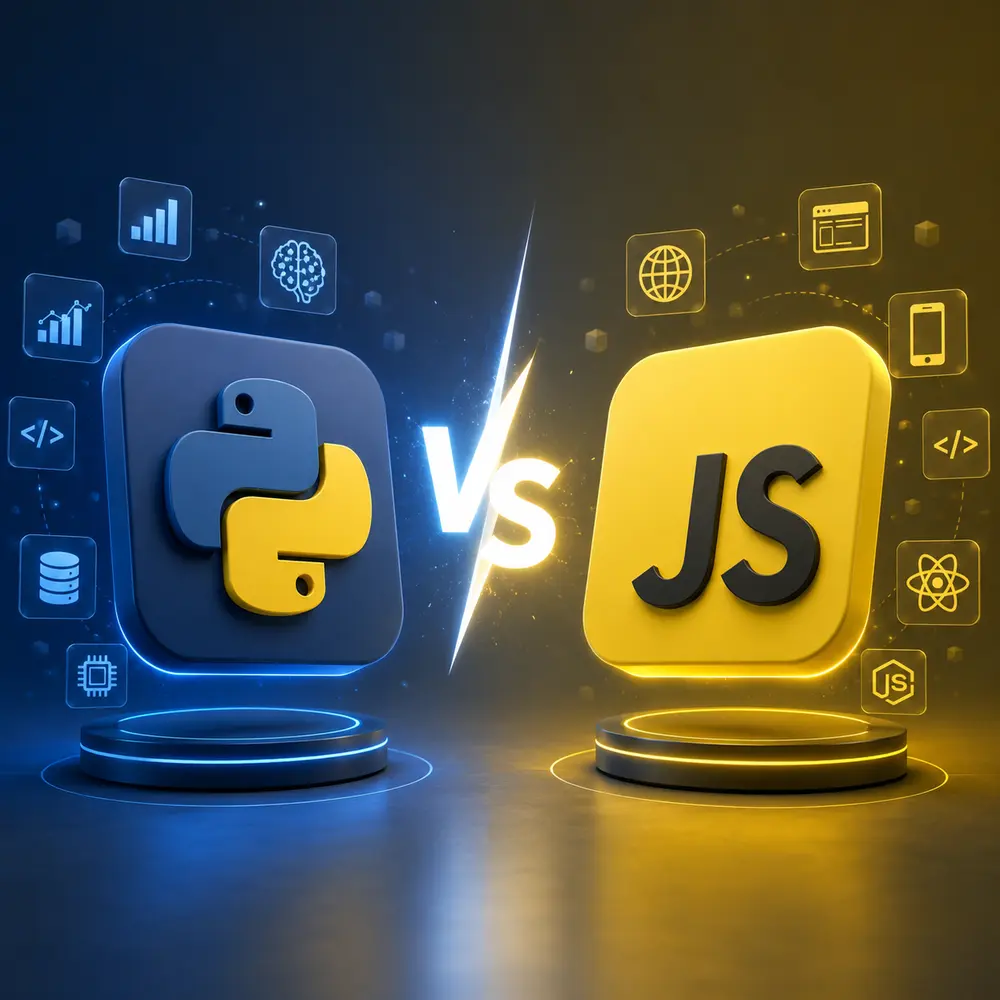
If you are new to coding, one question keeps coming up before anything else — should you learn Python or JavaScript first? Both languages are at the very top of the programming world in 2026. Both have millions of users, strong job markets, and beginner-friendly learning resources. But they serve different purposes and take you down very different career paths. This guide gives you a real, research-backed answer so you can pick the right language, start learning fast, and build a strong future in tech.
Why Python and JavaScript Dominate in 2026
Before comparing the two, it helps to understand just how important they are right now. According to the Stack Overflow Developer Survey 2025, JavaScript is used by approximately 66% of all professional developers — making it the most widely used language in the world for over a decade straight. Meanwhile, Python has reached a record-breaking 26.14% rating on the TIOBE Index, the highest score any programming language has ever achieved in that index’s history.
These numbers tell a clear story. Python is dominating the AI, data science, and automation space. JavaScript is the backbone of the web. Both languages are essential, in-demand, and not going anywhere soon. The real question is — which one fits your goals?
What Is Python? A Quick Overview
Python is a general-purpose, high-level programming language created by Guido van Rossum in 1991. Its design philosophy focuses on clean, readable code that almost looks like written English. This makes Python one of the most beginner-friendly languages you can find. You do not need a lot of experience with tech to understand what a Python script is doing — the syntax is that clear.
In 2026, Python is the default language for artificial intelligence, machine learning, data science, automation, and scientific research. Libraries like TensorFlow 2.14, PyTorch 2.2, NumPy 2.0, and Pandas 2.0 are all built around Python. For anyone who wants to work in the AI industry, Python is essentially non-negotiable.
Key Python Use Cases in 2026
Understanding python use cases helps you decide if it matches what you want to build. Here are the main areas where Python leads:
- Artificial Intelligence and Machine Learning — Frameworks like PyTorch and TensorFlow run on Python. Over 80% of machine learning engineers use Python as their primary language.
- Data Science and Analytics — Python is the top tool for working with large data sets, building dashboards, and running statistical analysis.
- Backend Web Development — Python frameworks like Django 4.2 and Flask 3.0 are widely used to build powerful, scalable web servers and APIs.
- Automation and Scripting — Python is the go-to language for writing scripts that automate repetitive tasks, process files, or scrape data from websites.
- Scientific Computing — Research institutions and universities use Python heavily for simulations, models, and experiments.
What Is JavaScript? A Quick Overview
JavaScript is the only programming language that runs natively inside every web browser. It was created in 1995 and has grown from a simple tool for making web pages interactive into one of the most powerful and flexible languages in existence. Today, JavaScript is used for both frontend development (what users see) and backend development (server-side logic through Node.js).
The npm package ecosystem for JavaScript now contains over 2 million packages — making it the largest open-source library ecosystem in the world. If you want to build websites, web applications, mobile apps, or interactive tools that users engage with directly, JavaScript is the language that powers all of it.
Popular JavaScript Frameworks You Should Know
One of JavaScript’s biggest strengths is its ecosystem of javascript frameworks. These tools make building real-world applications much faster. The most widely used ones in 2026 include:
- React — Built by Meta, React is the most popular frontend framework for building user interfaces. Used by companies like Facebook, Instagram, and Airbnb.
- Next.js — A React-based framework for building full-stack web applications with server-side rendering and static site generation.
- Vue.js — A lightweight, beginner-friendly alternative to React, popular in both startups and enterprise projects.
- Node.js — Not a framework but a runtime that lets JavaScript run on the server side, opening the door to backend and full stack development using only JavaScript.
- Angular — A full framework maintained by Google, popular in enterprise-grade applications.
These javascript frameworks are what make JavaScript such a versatile language. A developer who knows React and Node.js can build the entire frontend and backend of a web product — which is why full stack development with JavaScript is one of the most in-demand skill sets in 2026.
Python vs JavaScript: Syntax and Ease of Learning
If you are asking about the best programming language beginner developers should start with, syntax matters a lot. Here is a simple comparison:
Python example:
if 5 > 2:
    print("Five is greater than two!")
JavaScript example:
if (5 > 2) {
    console.log("Five is greater than two!");
}
Python reads almost like a sentence. There are no curly braces, no semicolons, and the indentation does the work. For most absolute beginners, Python feels less intimidating and easier to understand right away.
JavaScript has more symbols and stricter syntax rules. It can feel slightly more complex at first, especially around concepts like asynchronous programming. However, JavaScript gives you something Python cannot — you can open a browser and instantly see your code in action. That visual feedback is incredibly motivating for beginners who want to build real things fast.
The bottom line: Python wins for pure readability. JavaScript wins for instant, visible results. The best programming language beginner developers pick really depends on whether they want clarity first or quick results first.
Backend vs Frontend: Where Each Language Lives
Understanding backend vs frontend development helps clarify which language fits your goals.
Frontend development is everything the user sees and interacts with — buttons, menus, pages, animations. This is almost entirely the territory of JavaScript. No other language runs directly in the browser. If you want to build the visual side of a website or app, you need JavaScript.
Backend development is the server-side logic — databases, APIs, user authentication, and data processing. Both Python and JavaScript (via Node.js) are excellent for backend work. Python with Django or Flask is a very popular choice for backend APIs. JavaScript with Node.js and Express or NestJS is equally powerful and has the advantage of using one language across the entire stack.
For full stack development, you can use JavaScript alone — building both the frontend with React and the backend with Node.js. With Python, you would typically need JavaScript on the frontend anyway, which is why many developers end up learning both over time.
Python vs JavaScript Salary in 2026
Money matters, and the python vs js salary comparison is worth studying before you commit to a learning path.
According to 2026 US market data:
- Python developers earn an average of $120,000–$165,000 per year. Python specialists in AI and machine learning can earn $150,000–$300,000 at senior levels.
- JavaScript developers earn an average of $110,000–$155,000 per year. Senior React or full-stack engineers can reach $140,000–$250,000 at major tech companies.
When comparing python vs js salary, Python has a slightly higher ceiling because of the AI and ML premium. AI/ML specialists are seeing salary increases of 20–30% year-over-year in 2026, driven by the surge in AI job postings — which are up 85% compared to the previous year. However, senior JavaScript developers who master full stack development also command very strong pay.
The real takeaway here is that specialization matters more than language choice. A developer who is excellent with Python in machine learning or an expert JavaScript full-stack engineer will both earn very well in today’s market.
Job Market: Who Is Hiring More in 2026?
JavaScript has approximately 450,000 open job postings on LinkedIn in the US, while Python has around 350,000. In terms of sheer volume, JavaScript leads. But when you look at the fastest-growing roles, Python is pulling ahead fast — Python job postings grew 18% year-over-year in Q1 2026, driven almost entirely by AI and data engineering positions.
According to industry data, Python positions outnumber JavaScript roles by approximately 2:1 in data science and AI-specific fields. Meanwhile, JavaScript dominates web development hiring. With 92% of professional developers using JavaScript in some form, every company with a web presence needs JavaScript skills.
The good news for beginners: both languages have strong, growing job markets. You are not making a risky choice either way — you are choosing between two different types of opportunity.
Python vs JavaScript for Coding Bootcamps
If you are considering a coding bootcamp to kick-start your career, it is worth knowing that both languages are widely taught. Many coding bootcamp programs offer tracks for web development (primarily JavaScript) and data science or AI (primarily Python).
According to 2026 data, coding bootcamp graduates have a 70–80% employment placement rate within six months, with starting salaries averaging around $70,000. Whether you come out of a coding bootcamp with strong JavaScript skills or solid Python knowledge, you will find real entry-level opportunities waiting for you.
One important note: over 80% of US computer science programs now use Python as the introductory teaching language. This means Python is widely considered the best first language from an academic perspective. But for coding bootcamp students who want to build something visible and get hired fast in web roles, JavaScript is often the recommended starting point.
Should You Learn Python or JavaScript First? The Clear Answer
When people ask whether to learn python or javascript first, the answer always comes back to your goal. Here is a simple decision guide:
- Choose Python first if you want to work in AI, machine learning, data science, automation, or research. Python’s simple syntax, rich libraries, and dominant position in the AI industry make it the clear winner for these paths. Python is also widely recommended as the best programming language beginner developers should start with if they are not yet sure of their direction.
- Choose JavaScript first if you want to build websites, web apps, or pursue full stack development. JavaScript is the only language that works natively in browsers, and its javascript frameworks like React and Node.js cover both frontend and backend work. The visual feedback of seeing your code come to life in a browser is also a huge motivation boost for beginners.
- Not sure yet? Start with Python. Its clean syntax makes the fundamentals of programming easier to grasp. Once you understand variables, loops, functions, and logic — switching to JavaScript is mainly a matter of learning new syntax, not new concepts.
Many developers eventually learn python or javascript alongside each other. A common real-world stack in 2026 is a React or Next.js frontend (JavaScript) combined with a FastAPI or Django backend (Python) for AI-powered features. Knowing both makes you incredibly valuable to employers.
Python and JavaScript Together: The Full Stack AI Developer Path
In 2026, the most competitive developers combine both languages. A full stack development path that includes JavaScript for the frontend and Python for the backend or AI layer covers nearly every type of web and tech product being built today. This combination opens doors in startups, enterprise companies, and the AI industry simultaneously.
If you are building toward a complete career in tech, the suggested learning path is:
- Start with one language and master the basics — variables, loops, functions, and data structures.
- Build small projects to apply what you learn.
- Learn the most relevant framework — React for JavaScript, Django or FastAPI for Python.
- Then expand into the second language once you are confident with the first.
The programming concepts you learn in one language transfer directly to the other. Once you understand how code works, picking up a second language is faster than you expect.
Pros and Cons: A Quick Summary
Python – Pros and Cons
- Pros: Beginner-friendly syntax, dominant in AI/ML, clean and readable code, strong job demand in data science, excellent libraries.
- Cons: Slower execution in browser-based tasks, not native to web browsers, less visual for beginners starting out.
JavaScript – Pros and Cons
- Pros: Runs in every browser, instant visible results, powers both frontend and backend, massive ecosystem of javascript frameworks, highest total developer usage worldwide.
- Cons: Syntax has more quirks and edge cases, asynchronous concepts can confuse beginners, requires knowledge of HTML and CSS for full web development work.
Conclusion: Python vs JavaScript — Make Your Move in 2026
The python vs javascript debate does not have a single winner — it has two different paths leading to two different destinations. Python is your gateway into AI, data science, and automation — some of the fastest-growing and highest-paying fields in tech right now. JavaScript is your gateway into web development, full stack development, and building the products that millions of people use every single day. In 2026, both Python and JavaScript offer strong salaries, large communities, and a wealth of learning resources from online courses to coding bootcamp programs. If you want to work with AI, start with Python. If you want to build for the web, start with JavaScript. If you are not sure, Python gives you the cleanest starting point. Either way, the most important step is to pick one and start coding today. The skills you build in one language will carry you further than any debate ever will.