The tech industry is going through one of the biggest shifts in its history. AI agents are no longer a future concept — they are here, running workflows, making decisions, and changing how businesses operate every single day. If you work in technology, manage a team, or simply use digital tools at work, this change is already affecting you.
In 2026, the question is not whether AI will reshape the tech industry. That ship has sailed. The real question is: what does the industry look like now that AI agents have moved from labs to real production systems?
This article breaks down everything — what AI agents are, how they are changing the tech industry, where they are working best, what challenges still exist, and what the future looks like for professionals and businesses alike.
What Are AI Agents? A Simple Explanation
Before diving into the impact on the tech industry, it helps to understand what AI agents actually are. Simply put, an AI agent is a software system that can observe its environment, plan steps, and take action — all without a human giving instructions at every step.
Unlike a basic chatbot that answers one question at a time, an AI agent can break a big goal into smaller tasks, connect with different apps, use tools, and complete multi-step work on its own. Think of it as a digital co-worker who knows what needs to be done and gets it done.
What makes agents different from older AI tools is their autonomy. They can plan, remember, adapt, and even collaborate with other agents to finish complex jobs.
The Tech Industry Before AI Agents vs. After
To understand the scale of this change, it helps to compare the tech industry of just a couple of years ago to what exists today.
Before AI agents, automation was mostly rule-based. A system did exactly what it was programmed to do — no more, no less. Human workers still handled everything that required judgment, planning, or switching between tools. AI at that time was mainly good for one thing at a time: writing, answering questions, or classifying data.
After AI agents, the picture is very different. Agents can now coordinate with each other, handle entire workflows, and make low-level decisions without anyone telling them what to do next. The tech industry has moved from helping humans do tasks to building systems that can own tasks entirely.
How Big Is This Change? Key Numbers from 2026
The data makes it clear just how fast the tech industry is moving with AI agents.
The global AI agents market was valued at $7.63 billion in 2025 and has already reached $10.91 billion in 2026, growing at a remarkable pace. By 2033, it is projected to hit $182.97 billion — a compound annual growth rate of 49.6%.
According to Gartner, 40% of enterprise applications will include task-specific AI agents by the end of 2026, up from less than 5% just one year ago. That is a massive jump that shows how quickly agents are becoming a standard part of business software.
A report from PwC’s 2026 AI Jobs Barometer found that companies most exposed to AI have tripled their lead in workforce productivity growth compared to companies that have not adopted AI. In January 2026, more than 275,000 active job postings in the US already required some level of AI skills, according to CompTIA.
Meanwhile, 51% of enterprises are now running AI agents in production environments, and 88% of executives plan to increase their AI budgets because of agentic AI initiatives.
How AI Agents Are Reshaping the Tech Industry
1. Software Development Has Changed Completely
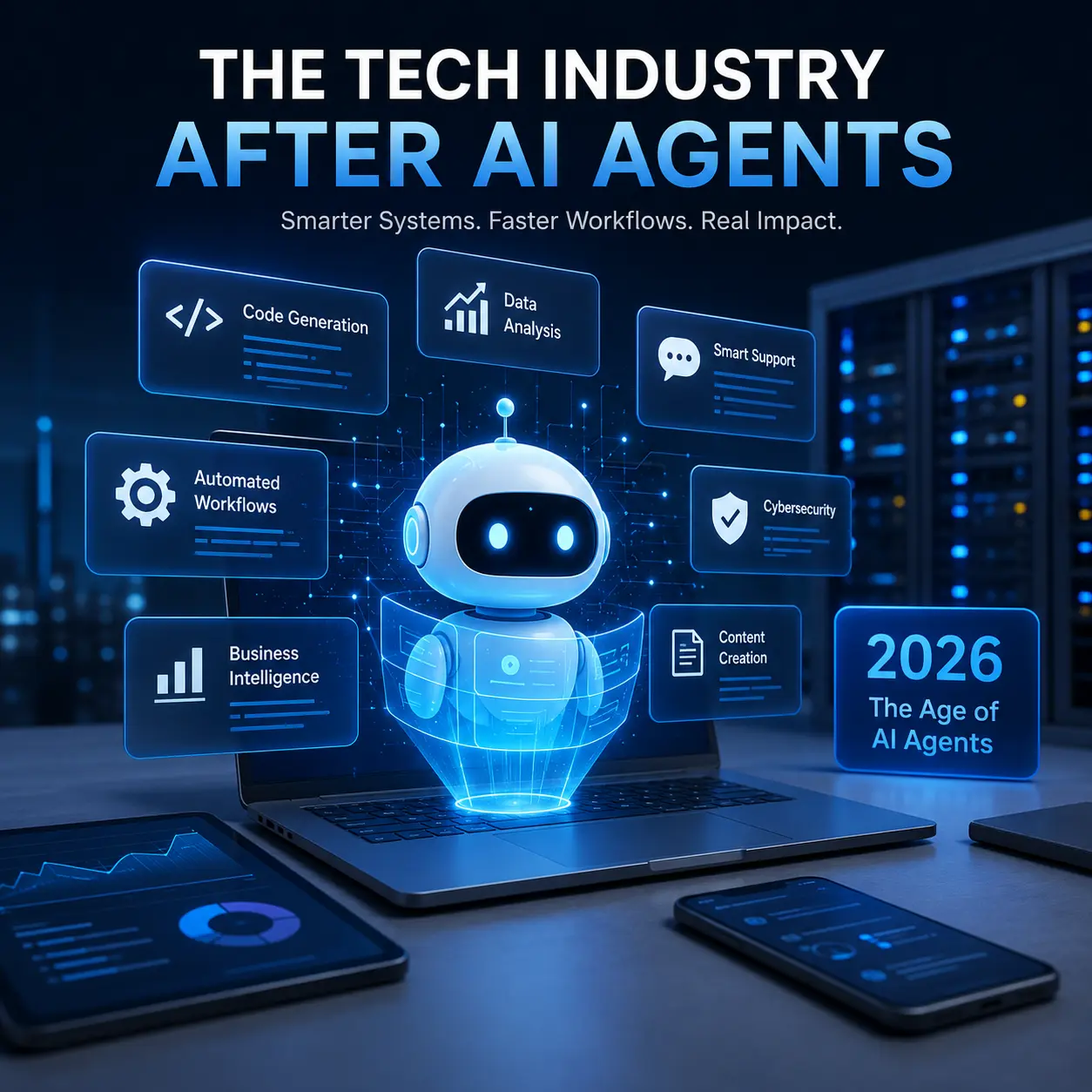
Software development is one area where AI agents have had the deepest impact on the tech industry. Today, the most advanced development teams write structured specifications and let autonomous coding agents handle implementation, testing, and debugging. Humans define the intent; the system delivers verified outcomes.
AI coding agents can now handle code generation, bug fixing, testing, documentation, code review, and technical debt reduction — all in one automated pipeline. This is not just making developers faster. It is changing what a small team of developers can realistically build and ship.
2. IT Operations Are Running on Autopilot
In the tech industry, IT operations used to require large teams to manage tickets, monitor systems, route requests, and handle incidents. AI agents are now taking over these functions at scale.
Agents in IT can automatically handle ticket routing, knowledge search, system monitoring, and routine support tasks. They can flag problems before humans notice them and even take corrective action. This is freeing up IT professionals to focus on more strategic and creative work.
3. Customer Service Is Being Redefined
Across the tech industry and beyond, customer service has seen one of the most visible transformations. AI agents now handle approximately 30% of customer service cases without any human involvement, according to recent enterprise data.
These agents do not just respond to basic questions. They can understand customer intent in natural language, access order history, query CRM records, and execute actions like processing returns or updating account details — all in a single conversation.
A real-world example: Danfoss, a global industrial manufacturer, deployed an agentic order management system on Google Cloud that now handles more than 80% of transactional decisions without human involvement.
4. Multi-Agent Systems Are Creating Digital Assembly Lines
The biggest shift in the tech industry right now is the move from single AI agents doing one job to networks of specialized agents that work together. These multi-agent systems act like digital assembly lines, where each agent handles one part of a process and passes the work to the next.
Google Cloud describes this as moving from one-off prompts to “digital assembly lines that run entire workflows.” A marketing campaign, for example, might involve separate agents for research, content creation, personalization, scheduling, and performance tracking — all working together without a human managing each handoff.
5. Healthcare, Finance, and Logistics Are Being Transformed
The tech industry is not just changing itself — AI agents are spreading into every sector that relies on technology.
In healthcare, agents are automating billing, scheduling, prior authorizations, and patient monitoring. They can flag health risks in real time before they escalate into emergencies.
In finance, agents are performing continuous risk audits, detecting fraud, and even assisting with wealth management. The World Economic Forum says agentic AI is set to define a “transformative era” for financial services.
In logistics, companies like Suzano — the world’s largest pulp manufacturer — have deployed AI agents that reduced query handling time by 95% for 50,000 employees.
The Productivity Question: Are AI Agents Actually Working?
One fair question about AI agents and the tech industry is: do they actually deliver results, or is this just another wave of hype?
The data leans strongly toward real results. McKinsey research shows that initial agentic AI deployments deliver 3–5% annual productivity gains, while scaled multi-agent systems can increase enterprise growth by 10% or more. Anthropic’s research suggests AI can speed up some tasks by as much as 80%.
A Fortune 500 company using an agentic system reduced reporting time from 15 days to just 35 minutes, while cutting the cost per report from $2,200 to $9. That is not incremental improvement — that is transformation.
Still, the picture is not perfect. Only 23% of organizations say their agents have delivered significant ROI, even though 80% report some measurable economic returns. The gap between using AI agents and fully benefiting from them is still large for most businesses.
Jobs and the Tech Workforce: What’s Actually Happening
No topic around AI agents and the tech industry generates more debate than jobs. Here is what the data shows — without exaggeration in either direction.
According to the World Economic Forum, AI and automation will displace around 85 million jobs globally while creating 170 million new roles by 2030 — a net gain of 78 million positions. But the new roles require very different skills than the ones being displaced.
In the tech industry specifically, CompTIA forecasts net tech employment in the US will grow by 1.9% in 2026, adding 185,499 new jobs and bringing the total to nearly 9.8 million workers. LinkedIn’s 2026 Labor Market Report shows employers have already created at least 1.3 million AI-related job opportunities in the past two years.
Workers with strong AI skills earn 56% more than peers without those skills, according to PwC analysis. The Stanford HAI 2026 AI Index found that AI-related skills now appear in 2.5% of all US job postings — a 297% increase over the past decade.
Entry-level roles are feeling the most pressure. Employment among workers aged 22–25 in AI-exposed roles has declined by 13%. But mid-level and senior workers who learn to work alongside agents are finding their value increase, not decrease.
Challenges and Risks: The Honest Side of AI Agents
The tech industry is honest about the fact that AI agents come with real challenges, not just opportunities.
Governance Is the Biggest Problem
According to Deloitte’s 2026 report, only 1 in 5 companies (21%) has a mature governance model for autonomous AI agents. That means 80% of organizations are deploying agents without proper controls in place. Gartner warns that by 2028, 25% of enterprise breaches could be traced to AI agent abuse.
High Failure Rates Are a Real Concern
Not every AI agent project succeeds. Gartner estimates that more than 40% of agentic AI projects will be canceled by end of 2027, mainly due to escalating costs, unclear business value, and poor risk controls.
Data Integration Is Still Hard
80% of enterprise IT leaders report significant challenges in adopting AI agents. The biggest hurdle is connecting agents to existing tools and data systems — a process that is still complex and time-consuming for many organizations.
Security Must Come First
As AI agents gain more autonomy, security becomes critical. Microsoft’s VP of security describes the need for every agent to have similar security protections as a human worker — clear identities, defined access limits, and protection from attackers. Without this, autonomous systems can become serious vulnerabilities.
What Skills Do You Need in the Age of AI Agents?
For anyone working in or around the tech industry, the most practical question is: what should you learn?
The World Economic Forum projects that 39% of workers’ core skills will change by 2030. AI and big data sit at the top of the fastest-growing skills list. But the professionals standing out in 2026 are not just the ones who know how to use AI tools — they are the ones who combine AI fluency with judgment, creativity, and leadership skills that machines cannot replicate.
BCG research shows that employees who receive at least 5 hours of AI training show significantly higher confidence and usage. US job postings requiring AI skills grew 144% year over year as of April 2026, according to Lightcast data.
The professionals who thrive will be those who can direct AI agents, evaluate their outputs, catch their errors, and apply human context to situations where machines still fall short.
The Future of the Tech Industry With AI Agents
Looking ahead, the tech industry with AI agents looks very different from where we started. Several major shifts are on the horizon.
By 2028, Gartner projects that 15% of day-to-day business decisions will be made autonomously by AI agents — up from essentially zero in 2024. One-third of user experiences will shift from traditional apps to agentic front ends, where users interact with intelligent systems rather than fixed software interfaces.
By 2029, at least 50% of knowledge workers are expected to develop new skills specifically to work with, govern, or create AI agents. Global spending on AI is projected to reach $1.3 trillion by 2029.
IBM has publicly stated that 2026 will mark the beginning of a new era where quantum computing begins to outperform classical computers in specific domains — a development that will supercharge AI technology even further.
Every major technology wave in history — electrification, the internet, mobile — created more economic value and more types of work than it displaced. The AI agents wave appears to be following that same path. The companies and individuals who adapt fastest will capture the most value.
Pros and Cons of AI Agents in the Tech Industry
Benefits
- Massive productivity gains — some tasks sped up by up to 80%
- 24/7 availability without fatigue or inconsistency
- Ability to handle complex, multi-step workflows autonomously
- Significant cost reduction in repetitive, high-volume operations
- Freeing up human workers for creative and strategic tasks
- Faster decision-making powered by real-time data analysis
Challenges
- Weak governance and oversight in most organizations
- High failure rates for poorly planned projects
- Job displacement for entry-level and routine roles
- Data security and privacy risks at scale
- Integration complexity with existing tech infrastructure
- Uncertainty about who is responsible when an agent makes a wrong decision
Conclusion: The Tech Industry Has Already Changed
The tech industry after AI agents is not a future state — it is the present. AI agents are already running in production at thousands of companies, handling customer service, writing code, managing supply chains, monitoring health data, and much more. The pace of change in technology is faster than most people expected.
For businesses, the opportunity is enormous. For workers, the message is clear: learn to work with AI, not against it. The tech industry is not replacing humans — it is changing what humans need to do. Those who embrace AI agents as tools and collaborators will find more opportunity, not less.
The tech industry after AI agents rewards those who adapt early, govern responsibly, and invest in both people and technology together. That is the real story of 2026 — and it is only just beginning.